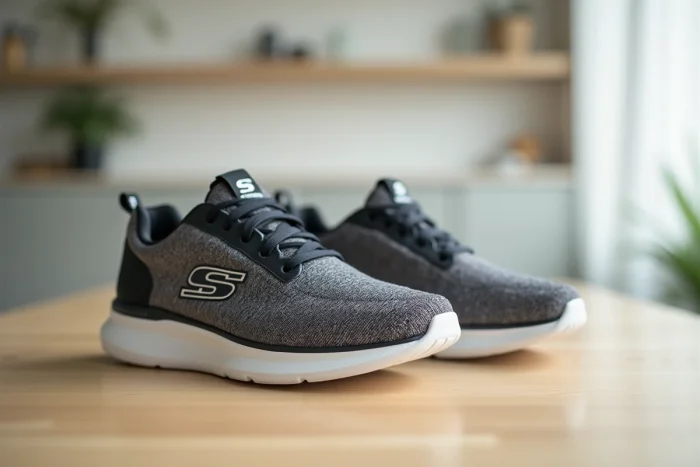
Skechers shoe counterfeits are widely circulating on resale platforms and some unscrupulous merchant sites. The American brand, positioned in the sports and leisure segment, is one of the preferred targets of counterfeiters, alongside Nike and Jordan models. Identifying a genuine pair of Skechers before purchase requires knowing where to look, and especially understanding the checkpoints that counterfeiters still struggle to reproduce faithfully.
Skechers and Customs Seizures: A Little-Publicized Legal Context
Online buying guides focus on stitching and logos but overlook the legal dimension of the problem. Skechers actively cooperates with customs authorities to seize shipments of copies before they reach consumers.
In November 2023, Skechers USA obtained a ruling from the U.S. International Trade Commission confirming the ban on importing models that imitate its soles and designs. This type of ruling strengthens border controls on products that closely resemble the originals.
On the European side, the 2024 report from EUIPO and Europol indicates a notable increase in seizures of counterfeit sports shoes since 2022. Postal shipments of small packages from Asian platforms represent a growing share of these interceptions.
Sports and leisure brands, a segment where Skechers is very present, are explicitly mentioned among the most affected. To understand how Skechers fit and verify the consistency of a model, the sizing remains an underestimated indicator when making a remote purchase.
SKU Code and Inner Label: Technical Checks on a Pair of Skechers
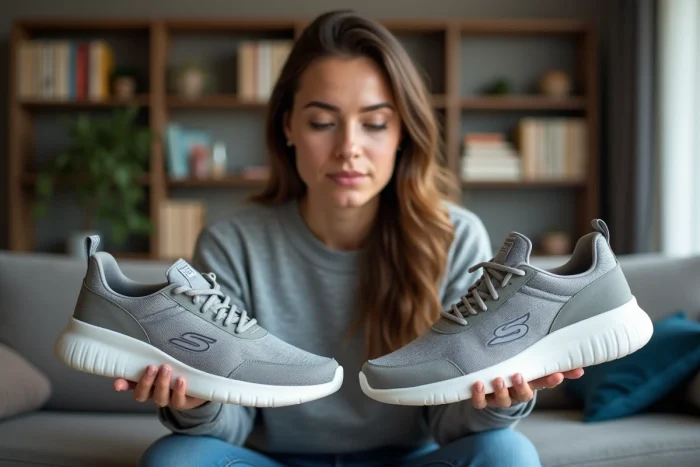
The SKU (Stock Keeping Unit) code serves as the first reliable filter. On an authentic pair of Skechers, this code appears on both the inner label of the shoe and the label on the box. Both SKU codes must match exactly. A discrepancy, even partial, almost systematically indicates a counterfeit.
The inner label itself deserves careful examination. Several elements help distinguish an authentic product:
- The typography is sharp, without smudges or misaligned characters. Counterfeits often feature slightly different fonts from those used by Skechers, with irregular spacing.
- The indicated country of manufacture (usually China or Vietnam for recent models) must be consistent with the information available on the official site for the relevant model.
- The serial number and size are printed uniformly. On copies, the ink tends to fade with simple finger rubbing, which does not happen on an original Skechers product.
A verifiable SKU code on the official Skechers website remains the quickest test before any purchase on a resale platform like Vinted or on a third-party site.
Material Quality and Finishes: What Skechers Counterfeits Fail to Reproduce
The quality of materials is probably the most difficult criterion to assess from a photo, but the most telling when held in hand. Skechers soles use proprietary foams (Memory Foam, Air-Cooled) whose density and rebound are specific. On a counterfeit, the insole is generally stiffer, thinner, and loses its cushioning after a few days of use.
The Skechers Logo and Its Engraving Details
The “S” of Skechers, present on the outsole and often on the side of the shoe, must be engraved or molded with sharp edges. A blurry, asymmetrical logo or one slightly misaligned with the stitching reveals a copy. Counterfeiters reproduce the general shape of the logo but fail on the depth of the engraving and the regularity of the curves.
The stitching itself tells a lot. On an authentic model, the threads are uniform, without excess or visible knots. The topstitching follows straight lines or regular curves. On counterfeits, one often observes protruding threads, zigzag stitches where they should be straight, or poorly adjusted seams between two pieces of fabric.
The Skechers Box: A Complementary Indicator
The original box features the logo, barcode, and SKU on a printed label, not hand-stuck. The cardboard is rigid, with a consistent grain. Counterfeits often use thinner cardboard, with colors slightly off from the characteristic blue of Skechers boxes.
Buying Skechers on Vinted or Online: Concrete Traps to Know
Resale platforms between individuals concentrate a significant share of Skechers counterfeits. Price serves as an initial signal: a new pair sold well below the catalog price should raise suspicion. Counterfeiters set attractive prices, often between a third and half of the official price, to trigger a quick purchase.
Some reflexes can help limit the risk before finalizing an order:
- Request detailed photos of the inner label, sole, and SKU code on the box. A legitimate seller has no reason to refuse.
- Visually compare the model with photos from the official Skechers site. Counterfeits sometimes present slightly different colors or altered proportions (thicker sole, shorter tongue).
- Check the seller’s history: a recent account offering many new pairs from different brands at rock-bottom prices presents a risky profile.
Field reports vary on the reliability of third-party authentication services for Skechers. These platforms are well-versed in Nike or Jordan models, but their expertise on Skechers remains less documented. Going through an authorized retailer or the brand’s official site eliminates this risk at the source.
The increasing sophistication of Skechers counterfeits makes every check useful, with none being sufficient on its own. Cross-referencing the SKU check, examining materials, and verifying the sales channel remains the strongest combination to avoid counterfeits and secure your purchase.