
We host a relative, a friend arrives for a few months, a family member moves in while looking for housing. When this person needs to justify their residence for an administrative procedure, it is the host’s responsibility to provide a certificate of accommodation. This document seems simple, but its legal implications are real, and errors in form or substance can block a file or even expose one to criminal penalties.
Criminal penalties for false accommodation certificates
We start with what most guides relegate to the end of the article because it is the point that should guide the entire drafting of the document. Writing a certificate of accommodation is producing a sworn statement. If the declared facts are false, Article 441-7 of the Penal Code applies.
An inaccurate certificate is punishable by one year in prison and a fine of 15,000 euros. We are talking here about a certificate that mentions a fictitious accommodation, an incorrect address, or that covers a person who does not actually reside at the indicated address.
The consequences vary depending on the pursued objective. When the certificate is used to unduly obtain a social benefit (allowances, RSA), the risk extends to the reimbursement of the amounts received and specific prosecutions for fraud. To fully understand the legal obligations of the accommodation certificate, it is essential to keep in mind that the sincerity of the document is not a formality; it is a legally sanctioned obligation.
Both the host and the guest can be prosecuted. The former for having drafted a false document, the latter for using a false document if they use one they know to be inaccurate.

Accommodation certificate for residence permit: required documents since June 2025
The application for a residence permit is the use case where refusals for incomplete files are most frequent. Since the amendment of Article R. 431-11 of the CESEDA, applicable since June 16, 2025, the documentary requirements have been specified.
In practice, the guest must submit a complete file including:
- The accommodation certificate itself, dated and signed by the host, certifying that the person indeed resides at their home
- A copy of the host’s identity document or residence permit
- A recent proof of residence in the name of the host (utility bill, rent receipt, tax notice)
The certificate alone is not sufficient for a residence permit application. This is a point that many applicants discover too late, at the time of rejection of their file on the ANEF platform.
Digital submission on the ANEF and rejection risks
Applications submitted online via the ANEF require the digitization of each document. An unreadable scan, a truncated document, or a partial submission (certificate without the host’s identity document, for example) triggers a request for additional information or even a complete rejection.
It is recommended to scan each document in PDF format, with a sufficient resolution for signatures and dates to remain legible. Submitting the three documents together avoids most blockages.
Validity period of the accommodation certificate according to the procedure
The accommodation certificate does not have a universal validity period. It is the recipient administrations that set their own freshness criteria.
For a residence permit application, proof of residence documents are generally accepted with a maximum age of six months. For a national identity card or passport (notably for a minor hosted by a relative), Service-Public indicates that the host’s proof of residence must be less than a year old.
In practice, it is better to date the certificate as close as possible to the submission of the file. A document written several months before the application raises questions about the continuity of accommodation, even if it remains technically acceptable.
Vehicle registration and other common procedures
The accommodation certificate also serves as proof of residence for vehicle registration, opening a bank account, or registering on electoral rolls. Responses vary on this point: some administrations accept a certificate older than three months, while others refuse it. Anticipating by producing a recent document remains the most reliable method.
Mandatory mentions in a compliant accommodation certificate
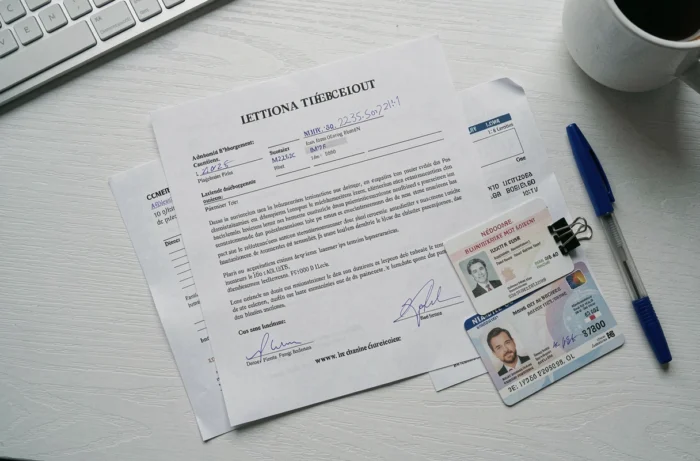
No Cerfa form is required. The certificate is written on plain paper, which allows for some leeway in form, but not in substance. Some mentions are necessary for the document to be accepted.
The certificate must include the complete identity of the host (name, first name, date and place of birth), the identity of the guest, the address of the accommodation, an explicit mention that the accommodation is granted free of charge (or, if applicable, with a contribution to costs), the date of drafting, and the handwritten signature of the host.
The most common omission concerns the host’s date of birth or the lack of precision regarding the gratuitous nature of the accommodation. These gaps are sufficient to have the document rejected, particularly at the prefecture.
Free accommodation or with financial contribution
The majority of certificates concern free accommodation. When the guest pays a contribution to costs (utilities, partial rent), it must be explicitly mentioned. Not declaring a real financial contribution can be considered a false declaration.
In this case, the certificate specifies the agreed amount and the payment terms. This transparency protects both parties in case of a tax audit or administrative verification.
The legal framework of the accommodation certificate is based on a simple principle: declare the reality of the situation, with the correct documents, at the right time. Rigor in drafting and completeness of the file remain the best way to avoid delays, refusals, and much more serious troubles than those provided for by the Penal Code.