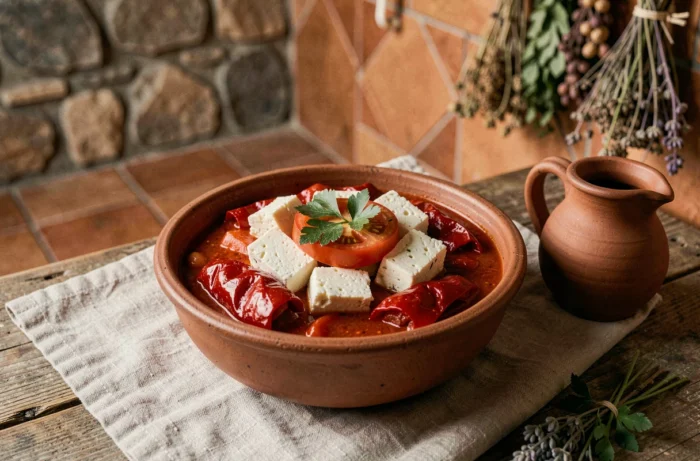
Fërgesë is not a fixed dish found in a national cookbook. It is a family of preparations whose variations differ according to cities, seasons, and available ingredients. This culinary ambiguity, far from being a flaw, tells the story of how Albanian cuisine has developed: through oral transmission, local adaptation, and garden produce.
Tirana or Gjirokastër Fërgesë: Dishes That Are Not Alike
To speak of “the” fërgesë as a unique recipe is to ignore the differences between regional versions. The one associated with Tirana relies on a trio of red peppers, tomatoes, and gjizë, a typically Albanian salty fresh cheese. The version documented by official Albanian tourism in Gjirokastër omits the peppers and focuses on gjizë, tomato, onion, and olive oil.
This distinction changes the texture and taste of the dish. Without peppers, the Gjirokastër fërgesë is milder, almost creamy. With the grilled peppers, the Tirana version gains a smoky depth. Both are worth tasting, but confusing them under the same name masks the richness of this family of dishes.
To recreate the Tirana version at home, the Albanian fergese recipe details the steps with ingredients accessible in France.
Vegetarian Fërgesë or Liver Fërgesë: Which Is the Original?
A debate persists among Albanian families and culinary sources. Some traditions present fërgesë me mëlçi (with liver) as the historical Tirana version. The preparation with peppers and cheese would then be its vegetarian variant, appearing later or reserved for other occasions.
The available sources do not resolve this controversy. What is documented is the coexistence of both versions in the restaurants of Tirana and in households. The vegetarian fërgesë is therefore not a modern by-product aimed at tourists: it is part of the Albanian culinary repertoire just like the meat version.
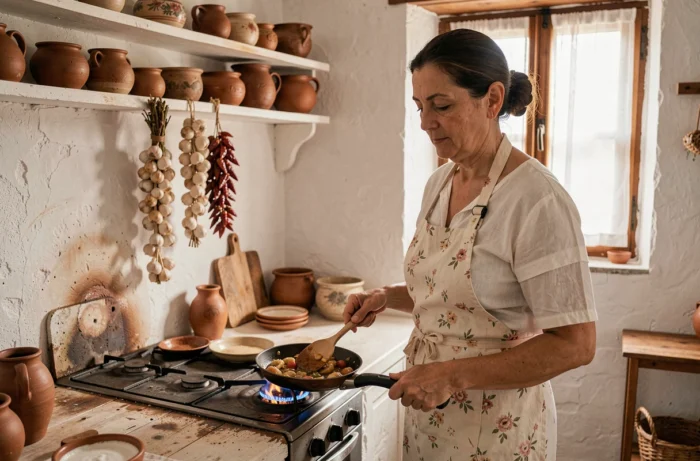
This ambiguity raises a practical question for anyone looking to cook “authentic.” Authenticity here depends on the family and the city, not on a national canon. A dish served in Tirana can be considered traditional even without meat.
Summer Fërgesë Without Cheese: An Unknown Version Outside Albania
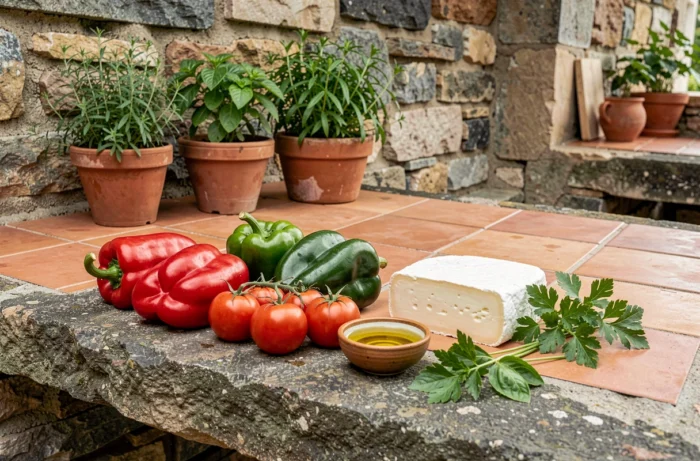
Most French-speaking recipes present fërgesë as a gratin of peppers with cheese. The fërgesë verore (summer version) tells a different story. It relies on peppers, tomatoes, garlic, and olive oil, without gjizë or any other cheese.
This dish is often eaten warm or at room temperature, making it closer to a Mediterranean mezze than a hot gratin. Fresh cheese is more involved in the winter version, which is richer and served bubbling in a clay dish.
The fërgesë verore well illustrates the seasonal logic of Albanian cuisine. In summer, when peppers and tomatoes are at their peak flavor, cheese becomes superfluous. In winter, gjizë adds fat and substance to less flavorful vegetables.
Ingredients for Fërgesë Verore
- Ripe red peppers, grilled or cooked until the skin peels off
- Fresh tomatoes reduced to sauce, or homemade tomato sauce if the season does not allow
- Fresh crushed garlic, added at the end of cooking to retain its aromatic power
- Generous olive oil, which binds everything together and replaces the fat from the cheese
Traditional Texture of Fërgesë: No Roux, No Yogurt, No Béchamel
Several Western adaptations of fërgesë add butter, flour, or yogurt to achieve a bound texture. These additions stray from the traditional method documented, where the binding comes solely from the gjizë melted into the reduced vegetables.
Gjizë, a salty fresh cheese with a grainy texture, softens with heat and mixes with the cooking juices of the peppers and tomatoes. The result is a consistency between fondue and ratatouille, without the heaviness of a white sauce.
To reproduce this texture without gjizë (which is hard to find outside Albania), salted white cheese or ricotta salata offer an acceptable approximation. However, fresh Italian ricotta, being too moist and soft, does not yield the same result.
How the Cheese Used Changes the Dish
- Gjizë: grainy texture, pronounced salty taste, partially melts during cooking without becoming liquid
- Ricotta salata: firmer, can be grated or crumbled, adds salt but less creaminess
- Fresh ricotta: too watery, dilutes flavors instead of concentrating them
- Crumble feta: a common alternative that adds acidity absent in the original version
The Clay Dish: A Utensil That Is Part of the Recipe
The mode of serving is an integral part of fërgesë. The dish traditionally arrives at the table in an individual clay container, still bubbling. This is not just a presentation detail: the clay retains heat and continues cooking at the table, allowing the cheese to lightly gratin on the surface.
Using a ceramic or cast iron dish produces a similar effect. A simple serving bowl, on the other hand, allows the dish to cool too quickly and prevents this final passive cooking phase that gives fërgesë its characteristic golden crust.
Fërgesë is shared with fresh bread, the only truly traditional accompaniment. Bread serves both as cutlery and plate, absorbing the juice and melted cheese. Adding it to a menu with rice or pasta follows a Western restaurant logic, not an Albanian usage.
Whether served with or without cheese, with liver or peppers, fërgesë remains a dish whose technical simplicity masks its real diversity. Its place in Albanian cuisine lies precisely in this plasticity: each household has its own version, and none can claim to be the only legitimate one.