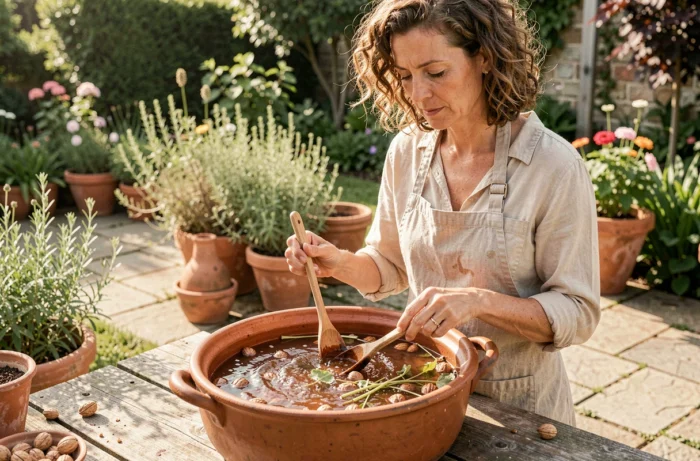
Natural brown dyeing does not rely solely on naturally brown ingredients. Brown can result from a chemical reaction between plant tannins and a metal mordant, or from a blend of pigments extracted from plants with complementary hues. Textile fibers absorb these dyes very differently depending on their type, weave, and pretreatment. The final result therefore depends as much on the process as on the dye material itself.
Tannins and iron: the chemistry behind plant-based browns
Most guides focus on listing the plants that produce brown. The more useful starting point, however, is understanding why some combinations create a deep brown while others yield only a dull beige.
Tannins, found in oak bark, walnut shells, walnut hulls, and tea leaves, are the most common pigment base for producing browns. Used on their own, they often create light shades with tawny or caramel undertones. The reaction between tannins and iron is what shifts the color toward darker browns, sometimes as dark as brown-black.
This reaction, known as complexation, changes the dye’s molecular structure once it has bonded to the fiber. Iron acts as a color modifier rather than simply as a fixative. In practical terms, a walnut-hull dye bath without iron produces a light golden brown, while the same bath with an added iron sulfate solution turns dark brown, or even gray-brown depending on the concentration.
Before exploring suitable plant sources, it is worth noting that the ability to dye fabric brown naturally depends as much on mordanting as on the choice of plant itself.
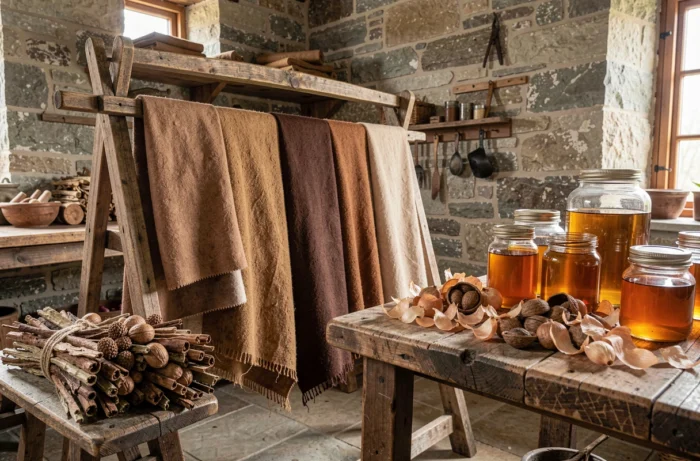
Plant sources for brown textile dye: beyond walnut hulls
Walnut hulls remain the go-to choice because they contain both tannins and a brown pigment (juglone) that dyes without a prior mordant. They are easy to use, but cover only part of the brown color range.
Other plant sources can expand the palette:
- Oak and chestnut bark, rich in gallotannins, produce golden beiges on their own and warm browns with an alum mordant, or cool browns with iron.
- Coconut shells and avocado skins produce pinkish browns on alum-mordanted cotton, which darken considerably with a post-dye iron bath.
- Strong black tea, steeped for a long time, yields a light tannin-rich brown that works well as a first layer before a second bath with a more pigmented plant.
- Madder roots, usually associated with reds, turn rust-brown on wool when the dye bath temperature exceeds a certain point or when the mordant contains iron.
Layering two different dye baths (for example, first using yellow onion skins, followed by walnut hulls) can produce complex browns that no single plant can create.
Textile fiber and mordanting: two variables that change everything
The same natural dye recipe will not produce the same color on wool, cotton, and silk. Research into dyeing fibers with plant extracts confirms that knitted wool, woven wool, and silk react differently to the same extract and mordant.
Cotton, a cellulosic fiber, does not naturally take up plant dyes as readily as wool or silk, which are protein fibers. To compensate, cotton often needs to be soaked first in soy milk or a tannin solution, then treated with an alum mordant. Without this preparation, the color remains pale and washes out.
Common mordants and their effect on color
Alum (aluminum potassium sulfate) fixes the color without changing it. Iron darkens and cools it. Copper shifts it toward greenish tones. For brown, using alum followed by an iron post-dip offers the best control: alum fixes the pigment, while iron adjusts its depth.
The amount of iron should be kept low. Too much can stiffen the fibers (wool becomes scratchy, cotton stiff) and produce a dirty gray rather than a brown. One teaspoon of iron sulfate in several liters of water is enough to noticeably darken the shade.
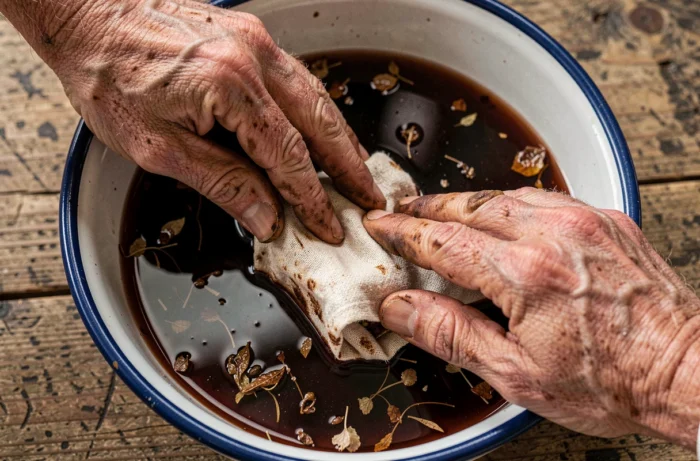
Colorfastness of plant-based brown dye: intensity and durability don’t go hand in hand
A deep, dark brown may look durable. That intuition can be misleading. Research on dyeing wool with blackthorn (Prunus spinosa) extracts shows that high color intensity does not guarantee resistance to washing or light. Results vary depending on the fiber and mordant used.
In practice, this means that a brown produced with too much iron may look very dark straight out of the dye bath, but quickly lose its depth after a few washes. A lighter brown, fixed with careful alum mordanting, may prove more stable over time.
Tips for improving colorfastness
- Wash dyed fabric in cold water with a mild soap that contains no bleaching agents to reduce color bleeding.
- Dry in the shade: direct sunlight accelerates the breakdown of plant pigments, especially on cotton.
- Rinse thoroughly after dyeing until the water runs clear, to remove unfixed pigment that would otherwise wash out the first time.
Reusing the dye bath reduces waste, but each successive bath loses some of its coloring power. The second dip produces a lighter version of the first, which is useful for intentional gradients but less suitable when you want to reproduce the same shade.
Achieving a plant-based brown that lasts means treating mordanting as the main step, not as a formality before dyeing. The choice of mordant, its concentration, and the type of fiber have a greater impact on how long the color lasts than the amount of plant material used in the dye bath.