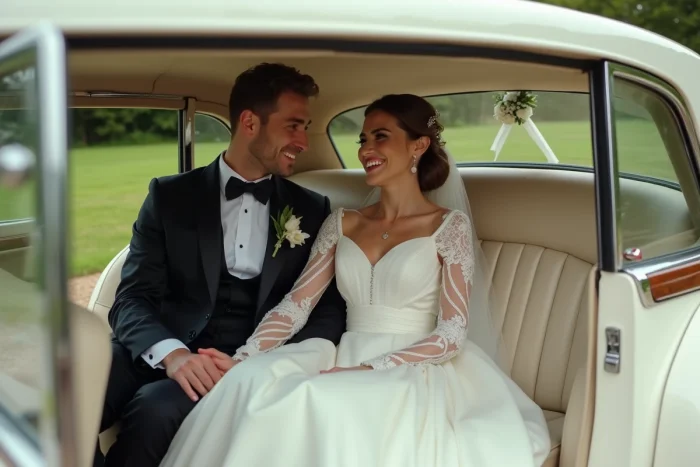
The question of passenger distribution in the wedding procession is not settled on the day itself at the town hall. It follows a precise protocol, inherited from civil and religious customs, which we systematically adapt to the logistical configuration of each ceremony.
Regulatory constraints of the wedding car procession
A wedding procession has no derogatory legal status. The Highway Code applies fully: red lights, speed limits, prohibition of prolonged honking. The Paris Police Prefecture regularly reminds, through circulars, that processions are subject to the same rules as any convoy.
Fines for abusive use of the horn or prolonged double parking are common, especially in the city center. We recommend designating a “tail-end” vehicle at the back of the procession, driven by a calm and experienced person, capable of maintaining cohesion without breaking the law.
Low Emission Zones (LEZ) significantly alter the composition of the procession. In Paris, Lyon, Grenoble, or Rouen, Low Emission Zones gradually exclude older vehicles that do not comply with the required Crit’Air sticker. A 2CV, a Volkswagen bus, or a classic car without a valid sticker simply cannot reach the town hall if it is located in a regulated area. Checking the Crit’Air classification of each vehicle in the procession is part of the preparation work, just like the itinerary.
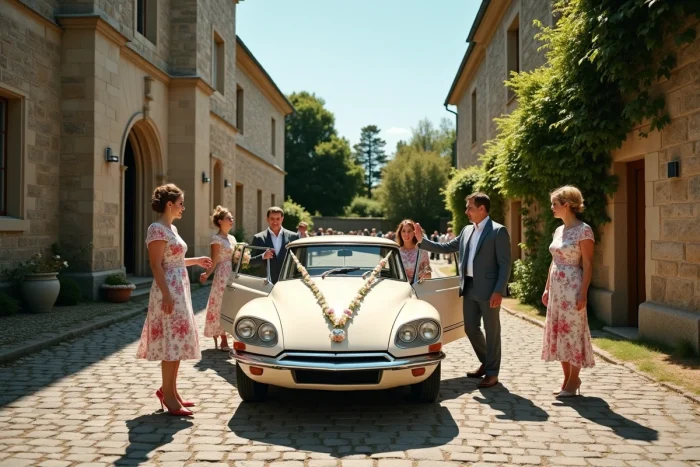
Passenger distribution by vehicle in the wedding procession
The French tradition distinguishes two phases: the outward journey (to the ceremony) and the return journey (to the reception venue). The composition of the cars changes between these two moments. To know precisely who gets in the bride’s car, several regional traditions are worth knowing.
Journey to the civil or religious ceremony
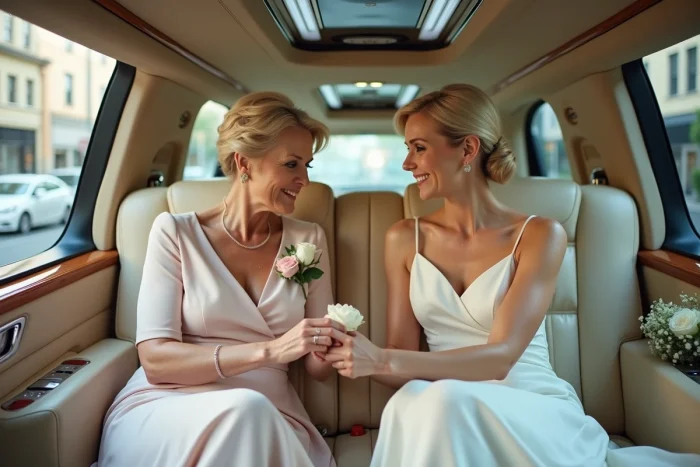
The future spouses arrive separately. This is the basic rule. The bride gets into the first vehicle, accompanied by her father or the person who will take her to the altar. The groom travels in a second vehicle, with his mother.
If the bride’s father is not present, she may be accompanied by her grandfather, a brother, a godfather, or anyone of her choice. The principle is not gendered but symbolic: the one who “gives” the bride shares her car.
Journey to the reception venue
After the ceremony, the couple leaves together in the main vehicle, which leads the procession. This is the only moment they share the same car. The parents take the second car, and the witnesses and bridesmaids take the third.
The order of the car procession follows a simple hierarchy:
- First car: the couple, possibly accompanied by a professional driver or the owner of the rented vehicle
- Second car: the parents of the couple (the four together or separated into two vehicles depending on the family configuration)
- Third car: the witnesses and bridesmaids
- Subsequent cars: close guests, followed by the rest of the convoy, without imposed order
The sweep vehicle closes the procession. Its role is to pick up any guest who is broken down, lost, or late. We observe that it is often neglected, even though it prevents most logistical incidents on the day itself.
Choice of driver and protocol for the bride’s car
The question of the driver is more delicate than it seems. Three scenarios arise in practice.
If the vehicle is rented with a driver, the question does not arise. The professional driver manages the journey, and the bride’s father sits next to his daughter in the back. This is the most comfortable configuration, as it frees relatives from any logistical responsibility.
If a relative is driving, the bride’s father is the traditional choice. He drives to the ceremony, then hands over the vehicle to the groom or a witness for the return. This change of driver must be anticipated: keys, seat adjustments, vehicle insurance.
If the groom drives himself after the ceremony, we strongly advise against any alcohol consumption during the intermediate reception. This point, rarely addressed, has direct implications for liability in case of an accident.
Decoration of the cars and coordination of the procession
The decoration distinguishes the couple’s vehicle from the rest of the procession. The work with the florist must incorporate a technical constraint: the fastening must not obstruct the driver’s visibility. Bouquets on the rear shelf and arrangements on the front hood remain the classic locations.
For the guests’ cars, ribbons or tulle matching the wedding colors are sufficient to identify the convoy. This visual marking serves both a practical and aesthetic function: it allows other road users to identify the procession and facilitates cohesion on an urban route.
Coordination of the itinerary
We recommend distributing the itinerary to each driver in the procession, via SMS or on paper, with the exact address and a synchronized departure time. A dedicated messaging group for drivers allows for reporting a delay or an unforeseen event without disturbing the couple.
- Scout the route the day before to identify any potential traffic or parking restrictions
- Allow for a buffer time between the end of the ceremony and the actual departure of the procession
- Check the availability of parking spaces at the reception venue for the entire convoy
The distribution of passengers, the choice of drivers, and adherence to the Highway Code form a triptych that every couple should validate at least two weeks before the date. A well-prepared procession does not need improvisation on the morning of the wedding.