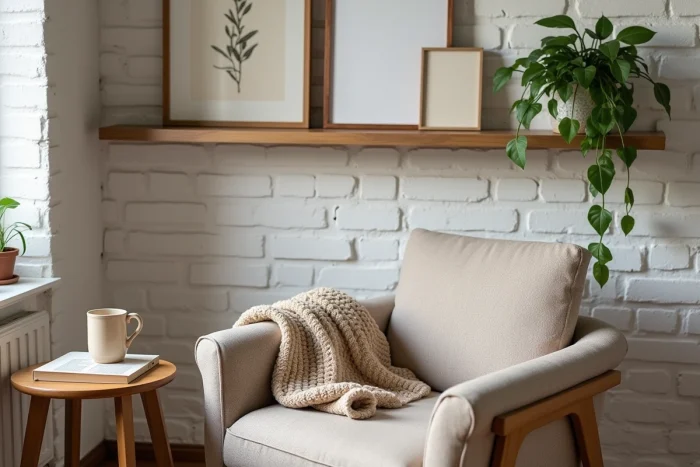
Creating a cozy home is not just about accumulating throws and candles. The feeling of comfort relies on measurable parameters: color temperature of lighting, proportion of absorbent materials in a room, level of decluttering. This article compares the levers that truly modify the perception of a welcoming interior, drawing on what recent approaches to “well-being by design” highlight.
Acoustics and indoor comfort: the forgotten parameter of decoration
Content about cozy homes almost exclusively discusses colors, lighting, and furniture. Acoustics are rarely addressed, even though they directly alter the feeling of safety and calm in a living space.
A room where sounds bounce off bare tiles, smooth walls, and large windows produces a reverberation that creates a cold sensation, even with carefully chosen lighting. Conversely, textiles and absorbent materials reduce reverberation and transform the perceived atmosphere without changing a single piece of furniture.
The elements that influence sound absorption are often the same as those recommended for a cocooning style: thick rugs, heavy curtains, cushions, filled bookshelves. Their decorative effect is real, but their acoustic effect is just as significant. Addressing the acoustics of a living room or common area means simultaneously working on auditory and visual comfort.
Specialized resources like those offered on angiesweethome.com allow for exploring arrangements that combine these dimensions, integrating textures and natural materials into a holistic ambiance approach.
Color temperature of lighting: comparison by usage and room
Adjustable lighting is identified as a central criterion for home comfort in recent interior design approaches. The color temperature, expressed in kelvins, determines whether light appears cold or warm. This parameter has more impact on the perception of a space than the wall color.
| Room | Recommended Temperature | Effect on Ambiance |
|---|---|---|
| Living room | Warm white (around 2,700 K) | Enveloping sensation, conducive to relaxation |
| Kitchen | Neutral white (3,000-3,500 K) | Visual comfort for tasks, without coldness |
| Bedroom | Very warm white (2,200-2,500 K) | Promotes sleep, dim ambiance |
| Office / reading nook | Neutral to cool white (4,000 K) | Concentration, but to be moderated in the evening |
| Entryway | Warm white (2,700-3,000 K) | Welcoming first impression |
The same living room can appear cold or warm depending solely on the color temperature of its lighting fixtures. Dimmable LED bulbs allow for transitioning from functional lighting during the day to ambient light in the evening, without changing the source.
Multiplying light sources (table lamps, floor lamps, string lights, wall sconces) at different heights creates areas of soft shadow. This layering is more effective than a single ceiling light, even of good quality.
Common mistake: the all-ceiling light
Centralized ceiling lighting projects a uniform light that flattens volumes. The room loses depth and character. Adding even a low lamp in a corner of the living room is enough to break this effect and create a cocooning ambiance without renovations.
Slow decor and sustainable materials: what replaces decorative accumulation
The “slow decor” trend redefines what we mean by a welcoming interior. The principle is simple: fewer objects, but objects chosen to last, made from natural materials, repairable or transferable.
This movement opposes disposable or seasonal decoration. A solid wood piece that ages well, a handmade pottery item, a raw linen textile brings warmth that plastic or laminated MDF cannot replicate, regardless of their design.
- Raw or oiled wood (oak, walnut, ash) provides visual warmth and ages beautifully, enhancing the character of a space over time
- Raw linen, wool, and thick cotton in curtains, cushions, or throws absorb sound and soften the lines of modern furniture
- Handmade ceramics (vases, lighting, door handles) introduce surface irregularities that make an interior lively and personal
- Thrifted or inherited objects tell a story and create an emotional layer that no catalog can provide
A sustainable interior is often warmer than a new one, because natural materials gain character over time. In contrast, synthetic materials tend to visually degrade, leading to replacements and starting the decoration process over again.
Decluttering and circulation: empty space as a comfort tool
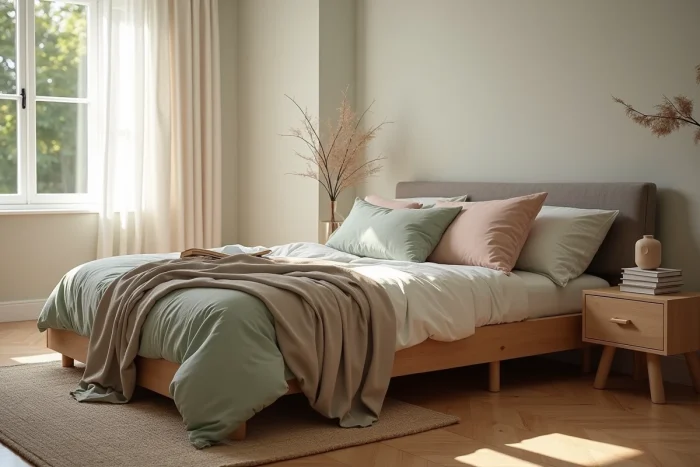
Decluttering is not about aesthetic minimalism. It is a direct lever on psychological well-being in a living space. A living room where circulation is fluid, where each object has a defined place, produces a sense of calm that decoration alone cannot compensate for.
The empty space around furniture matters as much as the furniture itself. A sofa placed too close to a coffee table, a hallway cluttered with shoes, an overloaded shelf: these details create a constant visual tension, even if unconscious.
Three concrete principles for decluttering without losing warmth:
- Remove one piece of furniture per room and observe for a week if its absence poses a real functional problem (in most cases, it does not)
- Group small decorative objects in threes or fives on a tray or dedicated piece of furniture, rather than scattering them across all surfaces
- Free the floor as much as possible: visible furniture legs and the absence of objects on the floor visually enlarge the room and facilitate cleaning
The link between storage and warmth perception
A tidy space is not an empty space. It is a space where every visible element is intentional. Books on a shelf, a plant in a corner, a throw on the armrest of a chair: these elements remain, but they breathe. The difference between a warm interior and a cluttered one often lies in the amount of visible air around the objects.
The “well-being by design” approach confirms this reading: acoustics, adjustable lighting, natural materials, and free circulation in the space form a system. Modifying just one of these parameters already changes the perception of a room. Combining them transforms a passage area into a truly welcoming living space.