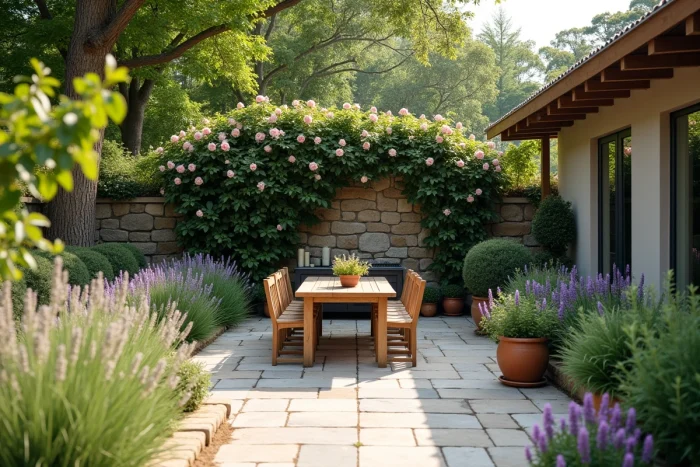
This year’s trends encourage rethinking garden design as a direct extension of the home, with codes borrowed from interior decoration. Furniture, materials, color palette: everything hinges on the coherence between the inside and the outside.
Visual continuity between interior and garden: the guiding principle of successful design
Have you ever noticed that a garden can seem disconnected from the house, as if it belonged to another universe? Landscapers are increasingly working to eliminate this break. The principle is simple: bring outside the materials and colors used inside.
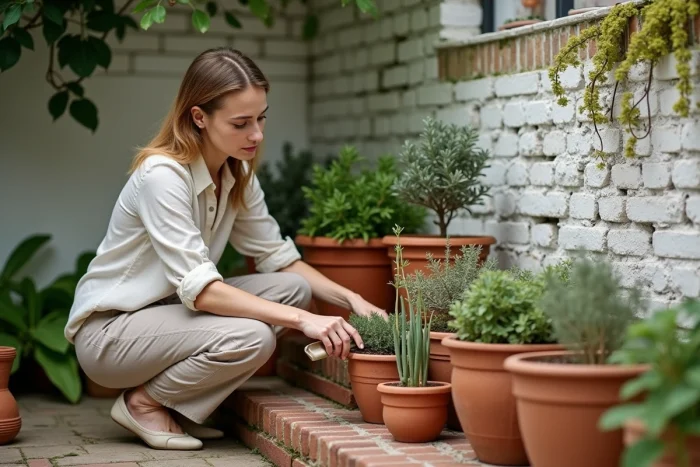
Specifically, if your interior focuses on light wood and earthy tones, extend this palette onto the terrace with similar cladding, terracotta pots, and furniture in sandy hues. Continuity is not just about plants. It extends to outdoor textiles (cushions, outdoor rugs), fence wall paints, and even lighting fixtures.
This approach transforms the transition from the French doors into a seamless flow. The garden becomes an additional room, not a separate backdrop. To find accessories and furniture that facilitate this coherence, the Les Embellies Déco website for the garden offers ranges designed with this in mind.
Outdoor kitchen and dining area: creating a true living space in the garden
Setting up a table and a barbecue in a grassy corner is something everyone has done. This year’s trend goes further: it’s about designing a real structured outdoor kitchen, complete with a work surface, storage, and a water point.
The idea is not to replicate a professional kitchen. A concrete or stone worktop placed on a low wall is sufficient. Add a sink connected to the garden’s water supply, some protected shelves, and a plancha or wood-fired oven. The dining area is organized right next to it, with a solid wood table and comfortable seating.
What changes compared to a simple barbecue
The difference lies in functionality. With a work surface, you prepare, cook, and serve in the same place. The trips back and forth to the house disappear. The entire meal takes place outside, from chopping vegetables to dessert.
For lighting, filament string lights or low-voltage wall sconces create a warm atmosphere without turning the garden into a neon-lit football field. Soft, targeted lighting makes the dining area usable until late evening.
Garden as a climate system: plants, shade, and water management
An inviting garden, during hot weather, is one that actively cools its environment. The choice of plants and their placement play a direct role in the perceived temperature around the house.
Deciduous trees planted to the southwest of the terrace filter sunlight in summer and allow light to pass through in winter. It’s a basic mechanism, but choosing the location of a tree based on the shade it casts radically changes the comfort of an outdoor space.
Plants and water management in the garden
Mediterranean plants (lavender, sage, ornamental grasses) require little watering once established. Paired with a thick mulch, they significantly reduce the garden’s water needs.
- Ornamental grasses (miscanthus, stipa) add movement and withstand drought without regular watering.
- A mineral mulch (gravel, pumice) limits evaporation and visually structures the flower beds.
- Evergreen shrubs like pittosporum or laurel create natural windbreaks, which reduces soil drying.
The goal is to design a garden that works with the local climate rather than against it. Less maintenance, less water, and a space that remains green even in the height of summer.
Multifunctional garden furniture and space-saving
Not all gardens span several hundred square meters. On a small terrace or a generous balcony, foldable or dual-purpose furniture makes all the difference.
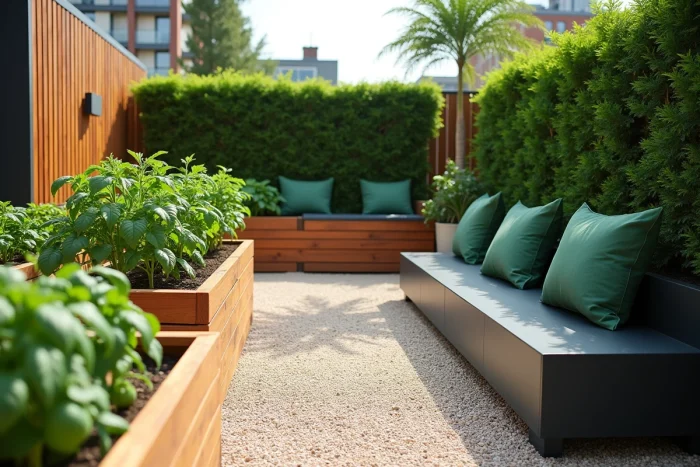
The storage bench exemplifies this logic: it provides comfortable seating and storage for cushions or tools. The wall-mounted folding table, fixed to the wall of the house or a shed, unfolds for meals and then disappears. The raised planters serve both as a vegetable bed and a visual separation between two areas.
Organizing zones without partitioning
In a small space, delineating a relaxation area, a dining area, and a plant area without putting up partitions can be achieved through the use of different materials on the ground. Composite wood for the dining area, stabilized gravel for the walkway, a natural stone slab under the sun lounger. These ground transitions guide the eye and organize the garden without shrinking it.
- An outdoor rug under the dining table signals the dining area without construction.
- Grouped pots of varying sizes create a mass effect even without in-ground planting.
- A screen made of reed or slatted wood visually isolates a reading corner without blocking light.
Three ground materials are enough to structure a small garden.
A trendy garden this year doesn’t necessarily require major renovations or an extravagant budget. Coherence between materials, a design focused on climate comfort, and well-chosen furniture can transform any outdoor space. The last point to keep in mind: a garden where you spend time deserves as much care as a room in the house.