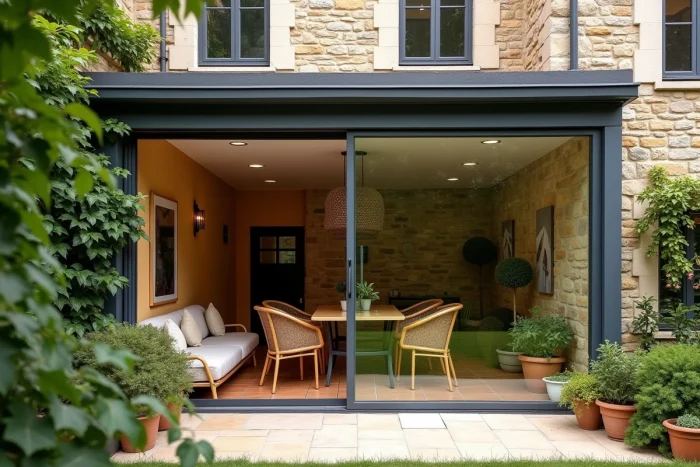
The custom veranda in Beaune raises a question rarely asked in local design guides: what thermal performance gap separates the different configurations of glazing and structure, and how does the RE2020 redefine the possible choices for this type of extension? Recent regulatory data and feedback from design offices allow for a more precise comparison of options than a simple materials catalog.
RE2020 and Veranda in Beaune: What the Summer Comfort Indicator Changes
Since the gradual implementation of the RE2020 (decree no. 2021-1004), new individual houses must comply with a summer discomfort indicator called DH (degree-hours). A thermally poorly sized veranda can push a project beyond this threshold, even if the rest of the house is compliant.
Several design offices report that uncontrolled thermally verandas lead to recommendations for fixed or movable solar protections, solar control glazing, and automatic opening management. Beaune, with its increasingly hot summers in Côte-d’Or, makes these parameters particularly sensitive.
Specifically, the choice of a custom veranda in Beaune now involves integrating these constraints from the design stage, or risk having to correct afterwards with blinds or solar films that are less effective than a solution thought out in advance.
Aluminum, PVC, or Mixed: Comparison of Structures for a Custom Veranda
The choice of structural material determines aesthetics, thermal performance, and budget. Here is a synthetic comparison of the three most common structure families for verandas in the Beaune region.
| Criterion | Aluminum | PVC | Mixed (alu/wood) |
|---|---|---|---|
| Profile Slimness | Very slim, large glazing possible | Thicker profiles | Intermediate |
| Native Thermal Insulation | Average (thermal break necessary) | Good | Good to very good |
| Maintenance | Almost none | Low | Periodic wood treatment |
| Architectural Compatibility (Beaune center) | Contemporary, adaptable | Limited in colors | Well perceived in heritage areas |
| Relative Budget | Medium to high | The most accessible | The highest |
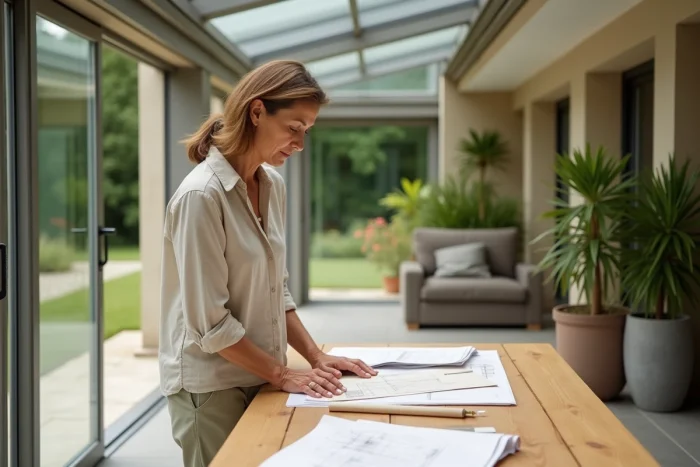
Aluminum dominates the custom veranda market for a simple reason: the slimness of its profiles maximizes the glazed area. However, without a thermal break, it transmits cold and heat much more than PVC.
PVC remains relevant for tight budgets and modest-sized verandas. Its main limitation is aesthetic: the thick profiles reduce brightness and integrate less well with stone facades, common in the center of Beaune.
The mixed aluminum-wood structure offers the best thermal compromise, but its cost and the maintenance of the interior wood hinder its adoption. It is particularly justified when the existing building is in a heritage area or near historical monuments in Beaune.
Solar Control Glazing and Opening Management: Technical Trade-offs
Glazing represents the largest thermal exchange surface of a veranda. Two technical parameters deserve particular attention during design.
- Solar Factor (Sw): solar control glazing reduces heat gains in summer without blocking all light. The lower the Sw, the more effective the solar protection, but brightness also decreases.
- Light Transmission (TL): it determines the amount of natural light that passes through the glazing. A good compromise for Beaune lies in a sufficient TL to enjoy winter light while limiting summer overheating.
- Automatic Opening Management: design offices recommend motorized openings that activate based on indoor temperature, to evacuate accumulated heat in the roof without manual intervention.
These three elements interact. A high-performance glazing without suitable ventilation is not enough to meet summer comfort thresholds. The combination of the two is what distinguishes a habitable veranda year-round from a space usable only six months.
Financial Aids and VAT: What Actually Applies to Verandas in Beaune
Confusion is common on this subject. A new veranda is not eligible for the MaPrimeRénov’ scheme. This exclusion has not changed with the reform that came into effect on January 1, 2024 (decree no. 2023-1664 of 28/12/2023).
However, certain energy performance works associated with the veranda may be subsidized. The replacement of existing joinery with high-performance sliding doors or the insulation between the veranda and the house falls within the scope of aids, provided that these works are not counted as an integral part of the veranda itself.
The applicable VAT also depends on the nature of the works. Energy improvement works on a home over two years old benefit from a reduced rate, while the construction of the veranda itself falls under the normal rate. Clearly distinguishing the two lots on the quote allows one to retain this advantage.
Orientation and Placement: Adapting the Project to the Beaune Climate
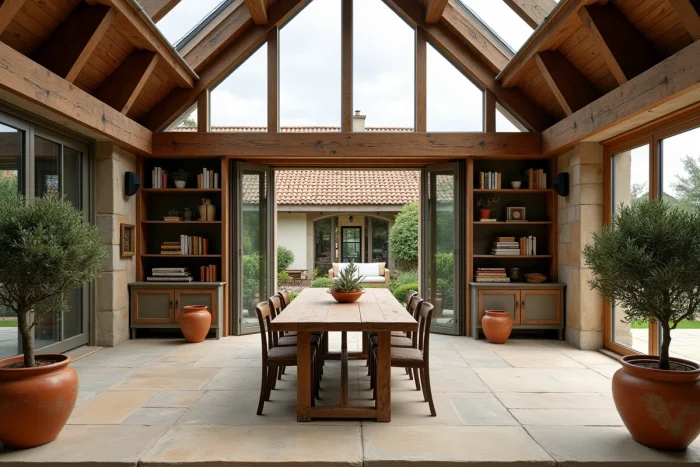
A south-facing veranda in Beaune captures maximum light in winter but becomes difficult to bear in July without properly sized solar protection. Conversely, a north orientation offers constant and soft light but limits passive solar gains during the cold season.
The east-west orientation is often an underestimated compromise. It reduces midday overheating while providing solar gains in the morning or late afternoon. For a main living space (living room, dining room), the southeast orientation limits overheating while capturing morning light.
The choice of placement also depends on the local urban planning plan of Beaune, which imposes variable setback and height rules depending on the areas. Checking these constraints before finalizing the project avoids costly modifications during the design phase.
Ultimately, the design of a custom veranda in Beaune hinges on three interrelated technical trade-offs: structure, glazing, and ventilation. The obligations arising from the RE2020 and the conditions for accessing financial aids make these choices more structuring than a few years ago, especially in a city where architectural heritage and the continental climate impose specific responses.