
The choice of a hedge trimmer relies less on the brand than on three technical parameters related to your hedge: the diameter of the branches, the cutting height, and the frequency of intervention. A poorly sized model puts strain on the motor, prematurely wears out the blades, and tires the operator well before the end of the linear.
Spacing of the teeth and cutting diameter: the criterion that guides overlook
The spacing between the teeth of the blade determines the maximum diameter of branches that the machine can cut cleanly. This is the most discriminating parameter, yet most product sheets place it after motor power.
A tight spacing is suitable for regularly trimmed hedges of privet, boxwood, or cherry laurel, whose shoots do not exceed a few millimeters. A wide spacing accommodates thicker semi-woody branches, typical of wild hedges or thujas neglected for several seasons.
We recommend measuring the largest branches of your hedge before any purchase. If the average diameter exceeds the advertised cutting capacity, the blade will chew instead of slice. The result: uneven cuts that promote fungal diseases and a motor that overheats unnecessarily. Detailed comparisons published on taillehaie.info allow you to cross-reference this criterion with manufacturer data for each range.
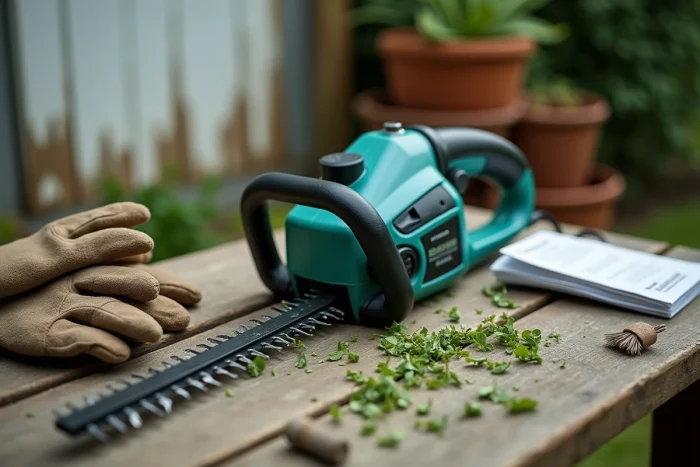
Blade length and actual yield on a hedge linear
A long blade covers more surface area per pass, but it is heavier and reduces maneuverability in corners. The right compromise depends on the geometry of your hedge, not a universal figure.
Straight hedges and L-shaped hedges
On a straight linear, a long blade reduces the number of passes and speeds up the work. For a hedge that turns at a right angle or borders a narrow path, a shorter blade offers significantly better cutting precision.
Weight and fatigue over half a day
Ergonomics surpasses raw power as soon as the session exceeds one hour. The vibrations transmitted to the arms and the weight in cantilever strain the wrist and shoulder joints. Recent battery models incorporate more advanced anti-vibration systems than previous generations, a point to check on the technical sheet before comparing watts.
The center of gravity of the machine is as important as its total weight. A well-balanced hedge trimmer weighing four kilos tires less than a poorly distributed model weighing three and a half kilos.
Battery, gas, or corded: decide based on terrain constraints
The battery versus gas debate has evolved. Lithium-ion battery models now cover the majority of residential uses without notable compromises on cutting power, provided the battery capacity is properly sized.
- The corded electric hedge trimmer remains relevant for small hedges located close to a power outlet, with a lower purchase cost and reduced weight. Its limitation: the cord, which requires an extension and constant vigilance.
- The battery model eliminates the constraint of the cable and generates less noise, a real advantage in dense residential areas or in condominiums. Autonomy varies greatly depending on the battery capacity and the resistance of the vegetation.
- The gas hedge trimmer retains the advantage for very long lines or hedges made of hardwood. Its motor torque handles thick branches without slowing down, but vibrations and noise levels remain significantly higher.
For interventions early in the morning or late in the day, local noise regulations may steer the choice towards an electric or battery model. We observe that this criterion increasingly weighs in the decision, even among landscaping professionals.
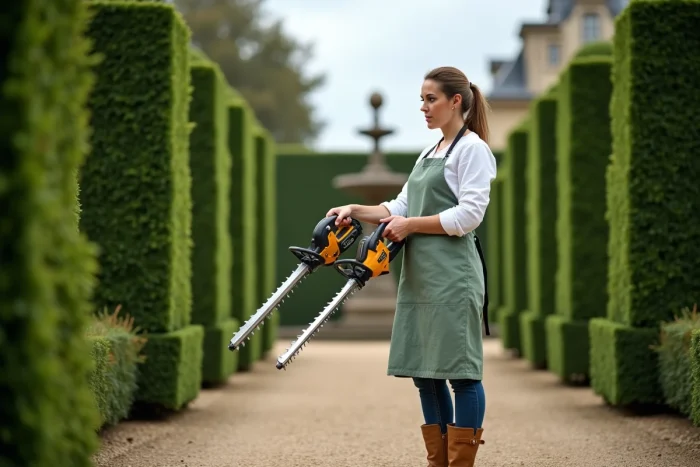
Pole hedge trimmer: safety and access to high hedges
Using a ladder to trim a tall hedge multiplies the risks of falling. A telescopic pole hedge trimmer allows you to reach the top of a hedge over two meters from the ground, with an adjustable cutting angle.
This type of machine adds weight and cantilever. The comfort of use directly depends on the quality of the harness or the rear handle. On a tall and long hedge, the pole reduces the duration of intervention compared to a classic model used on a stepladder, while keeping the operator in a stable posture.
Safety devices to check
The INRS emphasizes the importance of quick-stop devices on motorized gardening equipment. Before purchase, check for the presence of a double safety switch that stops the blade as soon as one hand releases the handle. On gas models, the blade brake must stop the movement in a fraction of a second.
- Integrated hand protection in the blade housing
- Anti-vibration system on the rear handle
- Rigid blade sheath for transport and storage
Blade maintenance: manganese steel and sharpening
Double-edged manganese steel blades retain their edge longer than standard steels. After each session, cleaning with resin and light lubrication prolongs the lifespan of the blade and maintains cutting quality.
Regular sharpening with a flat file suited to the angle of the teeth prevents straining the motor. If the teeth show visible chips, the blade must be replaced: a damaged blade tears the vegetation instead of cutting it, which weakens the hedge across the entire trimmed area.
Storing in a dry place, with the blade protected by its sheath, is sufficient to prevent corrosion between uses. A well-maintained hedge trimmer retains its performance for several seasons without heavy mechanical intervention.