
The Spanish simple future is formed by adding endings directly to the infinitive of the verb: -é, -ás, -á, -emos, -éis, -án. This regularity, common to the three groups of conjugation (-ar, -er, -ir), makes it one of the most accessible tenses for French speakers. Learning the Spanish future through songs helps to reinforce these endings through melodic repetition, without resorting to the brute memorization of a conjugation table.
Spanish future endings: why music anchors them better than a table
The uniqueness of the simple future lies in its base: the infinitive remains intact. Hablar becomes hablaré, comer becomes comerás, vivir becomes vivirá. There is no modification of the root for regular verbs, which simplifies the task.
Irregular verbs, on the other hand, modify their root while keeping the same endings. Tener becomes tendr-, salir becomes saldr-, poder becomes podr-. These modified roots are difficult to remember through simple reading.
A song that repeats a form like “tendré” or “saldrás” several times in a chorus creates an auditory loop. The brain then associates the irregular root with a specific melody, which facilitates spontaneous recall during oral expression.
Streaming platforms like Spotify now offer synchronized lyrics (via Musixmatch), allowing users to read the conjugated verb at the exact moment it is sung. According to a study from the University of Barcelona published in the journal RILE (nº 31, 2023), the use of subtitles to identify verb forms improves morphological accuracy, particularly for the simple future and the conditional.
Several resources compile songs suitable for this exercise, and the Emploi Plus website offers a selection focused on learning the future through music.
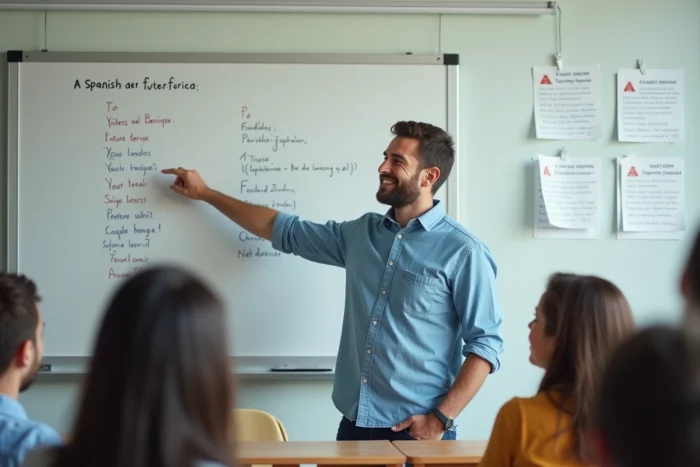
Concrete method to identify the Spanish future in lyrics
Listening to a song in Spanish without a method yields few grammatical results. Working on the future requires a simple but structured protocol.
Step 1: choose a title suitable for the level
A piece whose lyrics contain several verbs in the future, with a moderate vocal pace, is better than a fast title filled with slang. Pop ballads and Latin American romantic songs often use the future to express promises or projections (“te amaré”, “viviré”, “serás”).
Step 2: extract and classify verb forms
While listening, note each identified future verb. Then classify them into two columns:
- Regular verbs: those whose infinitive remains intact before the ending (cantaré, bailarás, viviremos). Check that the base corresponds to the complete infinitive.
- Irregular verbs: those whose root has changed (diré instead of deciré, haré instead of haceré, querré instead of quereré). Note them with the original infinitive next to them to memorize the transformation.
- Forms of “ir a + infinitive”: some songs mix the simple future and the periphrastic future (“voy a cantar” alongside “cantaré”). Distinguishing them helps to understand the nuance of use between immediate project and more distant future.
Step 3: listen again while singing the verbs
Revisit the song and sing only the parts containing a future, leaving the rest for passive listening. This segmentation forces attention on the verb form and its syntactic context. After several repetitions, try to sing the entire verse.
Simple future or periphrastic future: what Spanish songs reveal about actual usage
Grammar manuals present the simple future (hablaré) and the periphrastic future (voy a hablar) as two distinct tenses. In oral practice, and therefore in songs, the periphrastic future largely dominates in everyday language.
The simple future appears more in songs with poetic or solemn registers. A promise of eternal love will use “te amaré siempre” rather than “te voy a amar siempre.” The simple future carries a stronger emotional weight, an almost literary dimension.
Identifying this difference in lyrics allows for the development of a skill that traditional grammar exercises do not address: the choice of register based on communicative intent. A learner who knows that “seré” sounds more formal than “voy a ser” gains in expression nuance.

Building a playlist of Spanish songs to work on the future
The Instituto Cervantes reports in its “El español en el mundo 2024” that there is a notable increase in the use of Spanish playlists for educational purposes among those under 30, particularly for implicit grammar. Creating one’s own playlist dedicated to the future transforms a school exercise into a daily listening habit.
Here are some selection criteria for an effective playlist:
- Favor titles where the future appears in the chorus (the most repeated part, thus the most memorable).
- Vary artists and countries of origin to expose oneself to different accents: Spain, Mexico, Colombia, Argentina. The future endings remain the same, but the pronunciation changes.
- Include at least two or three titles containing irregular verbs in the future (tener, poder, venir, salir, hacer, decir, poner, saber, querer, haber, caber, valer) to avoid limiting to regular forms.
- Limit the playlist to about ten titles and refresh it every month to prevent boredom while consolidating knowledge.
Synchronized lyrics available on Spotify or YouTube allow for following the text word for word. Mentally highlighting each future form during listening transforms a moment of relaxation into an active grammar session, without perceived effort.
Learning the Spanish future through songs works because it exploits two complementary mechanisms: melodic repetition for regular endings and emotional context for irregular roots. A well-constructed playlist, listened to regularly with attention to verb forms, produces results that mere reading of a conjugation table cannot achieve.