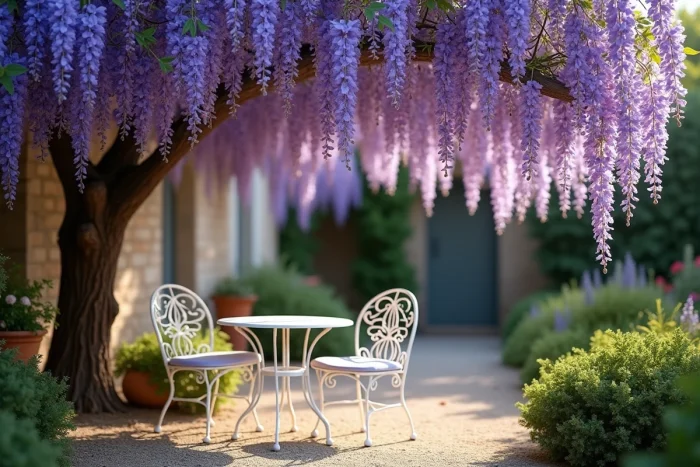
The wisteria trained in an umbrella shape is based on a radically different formation principle than the wisteria trained on a pergola or trellis. The subject is maintained on a single stem, often a grafted trunk at variable heights, and then the head is guided onto a horizontal framework to produce a dense plant cover. This architecture imposes constraints on pruning, staking, and variety selection that traditional climbing wisteria approaches do not address.
Grafting on a stem and forming the umbrella framework
A successful umbrella wisteria begins with the choice of rootstock. Grafted subjects on high stems, available for a few years from specialized French nurseries, come with a pre-formed trunk and a ready-to-use trained head. This time-saving advantage is considerable compared to a subject that one must train oneself, which will require several seasons of formative pruning before offering a true shade surface.
The grafting point is generally located between 1.80 m and 2.20 m in height. We recommend checking that this point is well healed and that the grafting collar does not show any cracks. A fragile grafting point on a high stem is the main risk of breakage under the weight of the adult foliage.
The head framework, made of galvanized steel or wrought iron, should form a rigid platform with a diameter suitable for the desired shade surface. The main branches are trained in a star shape from the top of the trunk to the edge of the platform. Each arm retains only two to three shoots to avoid overcrowding in the center of the crown. You can also find our tips for an umbrella wisteria that detail the sizing of this supporting structure.
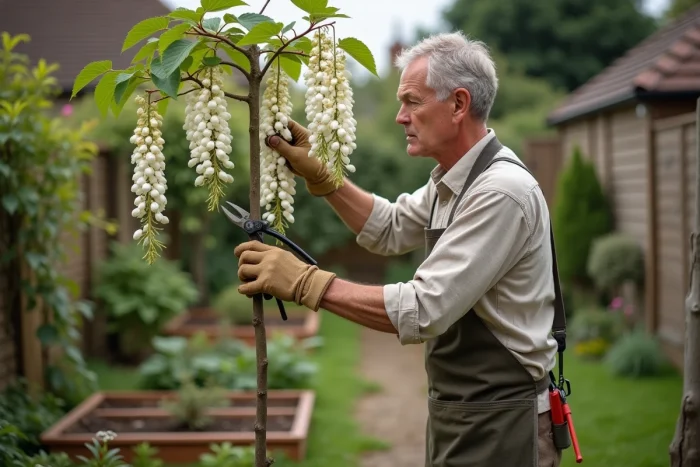
Pruning the umbrella wisteria: a two-pass protocol
Pruning is the factor that separates a dense umbrella from a drooping mess. For a wisteria trained as an umbrella, the protocol differs significantly from traditional espalier pruning.
The first pass occurs in summer, six to eight weeks after flowering ends. It involves shortening all lateral shoots of the year to five or six buds. This summer pruning channels sap towards the floral buds of the following year and maintains the compact silhouette of the platform.
The second pass, in winter (January-February), reduces these same shoots to two or three buds. It is this short cut that causes the densification of floral spurs and, consequently, the thickening of the leaf cover in spring. Without this discipline, the umbrella wisteria produces long drooping vines that pierce the platform and destabilize the structure.
- Systematically remove suckers that emerge from the trunk below the grafting point, as they belong to the rootstock and will not flower properly.
- Eliminate root suckers as soon as they appear to concentrate energy on the crown.
- Control tendrils that wrap around the metal framework, as an unpruned tendril can deform a steel tube in a few seasons.
Thermal stress and umbrella wisteria: adapting cultivation to the current climate
Feedback from gardeners in hot climates, particularly during the heatwaves of 2022 and 2023, has highlighted an underestimated problem. Umbrella-trained wisterias, exposed full south on very mineral terraces, have shown leaf burn and premature leaf drop. The umbrella shape, which exposes a large surface of leaves to direct radiation without the buffer of a wall or roof, amplifies this phenomenon.
A thick mulch at the base and regular watering become mandatory even for this plant known to be drought-tolerant once established. In pots on a south-facing terrace, the overheating of the substrate further accelerates root desiccation.
We observe that subjects planted in the ground with deep, cool soil resist significantly better than those in containers. If container planting is the only option, a pot of at least 80 cm deep, thermally insulated (double wall or wooden covering), limits temperature spikes at the root level.

Umbrella wisteria and regulations: the case of condominiums and housing developments
Several recent housing developments and condominiums now restrict the use of wisteria along facades and roofs. The potential damage (lifted tiles, deformed gutters, cracked masonry joints) justifies these limitations. The regulations of the eco-district LaVallée in Châtenay-Malabry or the landscaping charter of the Les Jardins de Nérac housing development in Lot-et-Garonne illustrate this trend.
The autonomous umbrella shape on a mast is, however, much better accepted by these same regulations, as it keeps the plant away from built structures. This is a strong argument for condominium owners who wish to enjoy wisteria without risking a conflict with the property management.
Before any planting, we recommend consulting the internal regulations or landscaping charter of your residence. These documents are generally accessible at the town hall or through the developer’s sales brochures.
Varietal choice for a dense cover umbrella
Not all wisterias are suitable for umbrella training. Varieties with short clusters and dense foliage produce a more homogeneous cover than cultivars with long drooping clusters, which are spectacular on a pergola but less effective in an umbrella form.
- Wisteria sinensis offers early flowering before the complete appearance of the foliage, creating a flowering dome effect in April-May followed by a dense green cover all summer.
- Wisteria floribunda, with longer clusters, is suitable if the goal is as much decorative as functional, but summer pruning will need to be more severe to maintain the compactness of the platform.
- Compact cultivars like ‘Amethyst’ or ‘Prolific’ are often favored by nurserymen for stem forms, as their moderate vigor makes it easier to control the crown.
The choice of cultivar also determines the weight that the structure will need to support at maturity. A vigorous wisteria on an undersized framework will eventually bend or break the arms of the platform.
The umbrella wisteria remains a demanding horticultural form, requiring rigorous pruning follow-up and a properly sized support. Planting a grafted subject shortens the path to a true vegetative umbrella but does not exempt from the two annual prunings. The recent climatic context also requires rethinking watering and substrate, especially in urban and mineral situations.