
A child crossing the living room in muddy socks five minutes after being reminded, a teenager skipping the clearing of the meal, a younger sibling negotiating every bedtime: we all know these scenes. Setting house rules is not enough; they must also be maintained over time. Here are ten concrete tips, tested daily, to establish a clear and truly respected family framework.
1. Formulate each rule in a short, affirmative sentence

We often tell children what they should not do. The problem is that a negative instruction (“don’t run”) does not indicate the expected behavior. Formulating the rule positively changes the game: “We walk in the house” provides a clear direction.
Each rule can be expressed in a sentence of fewer than ten words. The shorter it is, the easier it is for a three-year-old as well as a fourteen-year-old to remember it. We avoid double instructions (“Clean your room and set the table”) that dilute the message.
To find more tips for a harmonious family life, starting from this simple formulation base remains the best starting point.
2. Limit the number of house rules to five or six maximum

A household displaying fifteen rules on the fridge ends up enforcing none. A child’s brain, especially before the age of six, can only retain a small number of simultaneous instructions.
We select the rules around three axes: safety (no playing with boiling water), respect for others (no hitting), and household functioning (everyone clears their plate after the meal). Five or six well-chosen rules cover most situations.
3. Co-construct the rules in a family council

Imposing a framework without consulting the children produces superficial obedience, rarely genuine adherence. A family council, even informal (fifteen minutes on a Sunday evening), allows everyone to propose, discuss, and validate the rules.
Parents keep the final say on safety and non-negotiable limits. But allowing a seven-year-old to suggest bath time or the distribution of household chores reinforces their sense of responsibility. Feedback on this point varies by age, but from four years old, a child can participate in this type of exchange.
4. Display the rules with age-appropriate visual support
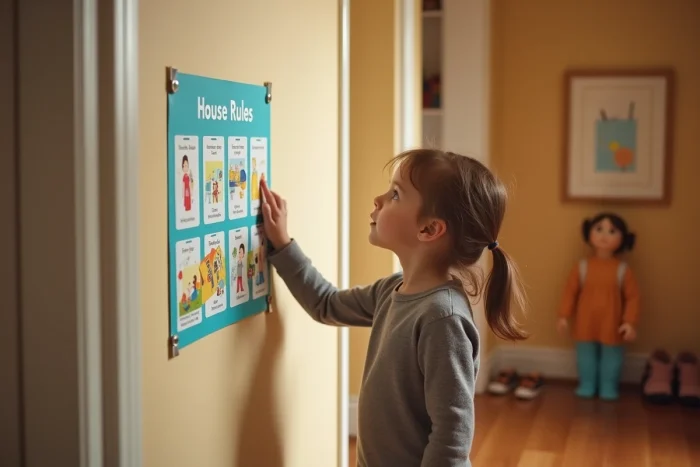
A sign written in small letters will not resonate with a child who cannot yet read. We use pictograms, drawings, or photos for younger ones. For older children, a magnetic board or a co-decorated poster works well.
Placing the display at child height, in a high-traffic area (entrance, hallway, kitchen), makes the rule visible when it applies. We can refer to it with a finger gesture instead of repeating the instruction out loud.
5. Associate each rule with a logical and known consequence in advance

An arbitrary sanction (“you are deprived of dessert because you shouted”) loses credibility if it has no connection to the broken rule. A logical consequence, announced in advance, works better.
- Toys not put away before dinner: they stay in an inaccessible bin until the next day.
- Screen time exceeded: the extra time is deducted the following day.
- Meal left without clearing: the child must return to clear before any other activity.
The goal is not to punish, but to link the act to its natural consequence so that the child understands the meaning of the rule.
6. Apply the same rules to adults in the household

A child immediately spots the gap between what they are asked to do and what adults do. If the rule says “we put our shoes in the entrance cabinet,” it also applies to parents.
Consistency among adults strengthens the framework. When both parents (or any adult caregiver) react the same way to a broken rule, the child has no loophole to exploit. We agree among adults in advance, not in front of the child.
7. Use time markers for daily routines
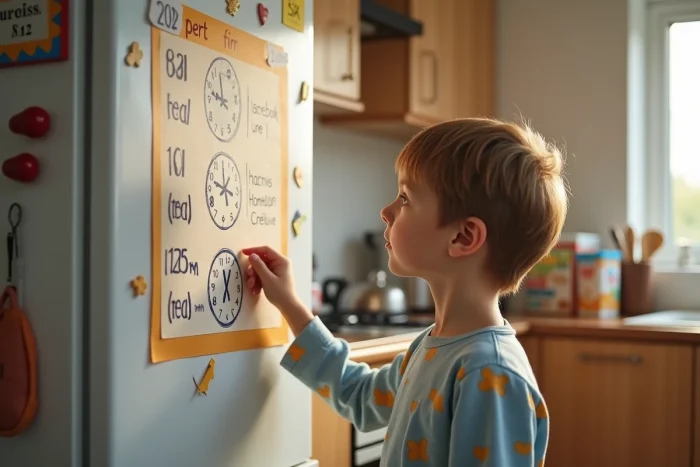
Conflicts around rules often explode during transitions: morning before school, returning home, bedtime. Associating rules with concrete time markers reduces negotiations.
We can use a visual timer for tooth brushing, a pictogram clock for the evening ritual, or simply a displayed sequence (“snack, homework, free play, bath”). The child knows what comes next without needing to be reminded at every step.
8. Value rule compliance rather than sanctioning deviations

We spend a lot of time pointing out infractions and little highlighting efforts. A simple “I saw that you cleared your plate without being asked” reinforces positive behavior.
Valuing does not mean a material reward for every action. Specifically naming the observed behavior (“you put away your sports gear all by yourself”) has more impact than a vague “well done” on the lasting respect for house rules.
9. Adapt house rules according to the child’s age

Asking a three-year-old to set the table like a ten-year-old creates frustration. We adapt the rule to the developmental stage.
- Before five years: put toys in a bin, place dirty clothes in the basket.
- From six to ten years: participate in meal preparation, manage their backpack, respect a defined screen time.
- Teenagers: contribute to household chores on a schedule, manage their laundry, respect curfew times.
Updating the rules at each school year start or significant birthday avoids the “baby” effect that older kids dislike.
10. Review family life rules at least twice a year

A rule set in September for a four-year-old no longer has the same meaning when they are six. The needs of the household change with the seasons, activities, and the growth of children.
We set two times a year (the start of the school year and the beginning of summer work well) to read the rules together. Some disappear because they have become automatic, while others emerge because a new need arises. Living rules are rules that are respected.
The strongest family framework is not the most rigid. It is the one that every family member understands, accepts, and sees applied by all, including adults. Better to have six clear and upheld rules than twenty forgotten instructions by the second week.