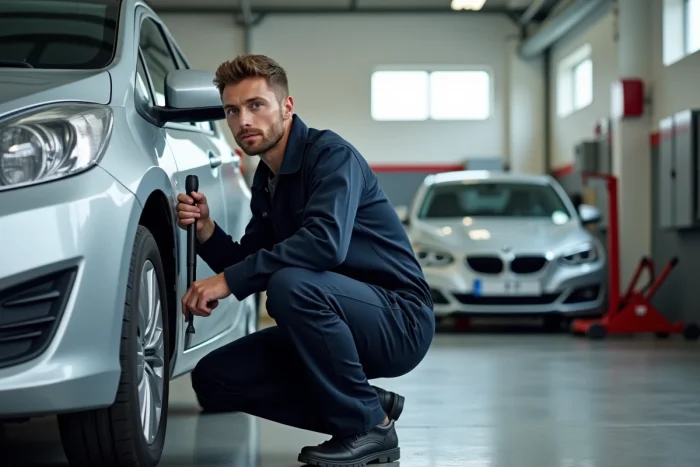
A self garage is an automotive workshop where the driver performs maintenance or repair operations on their vehicle themselves. The principle is based on renting an equipped space (elevating platform, pit, professional tools) and, depending on the structure, the presence of a technical facilitator capable of guiding the actions.
In Brittany, this model is developing around two urban centers, Lorient and Rennes, with options ranging from purely commercial garages to associative workshops with a social purpose.
Hybrid model in self garage: when the mechanic works alongside you
The most notable trend in Breton self garages is not pure self-service. More and more structures are adopting a co-participation model: the mechanic performs critical tasks (braking system, air conditioning, onboard electronics) while the user takes care of the rest.
This hybrid operation responds to a simple observation. The majority of people who walk through the door of a self garage today are not experienced DIYers. Feedback from solidarity workshops in Brittany shows a growing number of drivers without prior mechanical skills, coming for small operations (oil change, brake pad replacement, tire rotation) with the desire to learn.
To support these profiles, several structures formalize training paths: basics of diagnostics, safe tool usage, tasks not to attempt alone on an elevating platform. Interventions deemed too risky, particularly on the braking system or advanced electronics, are sometimes reserved for the professional present on-site.
In practice, by consulting the self garages in Lorient and Rennes, one quickly identifies which offer technical support and which operate strictly on a self-service basis. The difference lies in the hourly rate, but especially in the nature of the permitted interventions.
Associative or commercial self garage in Lorient and Rennes: what really changes
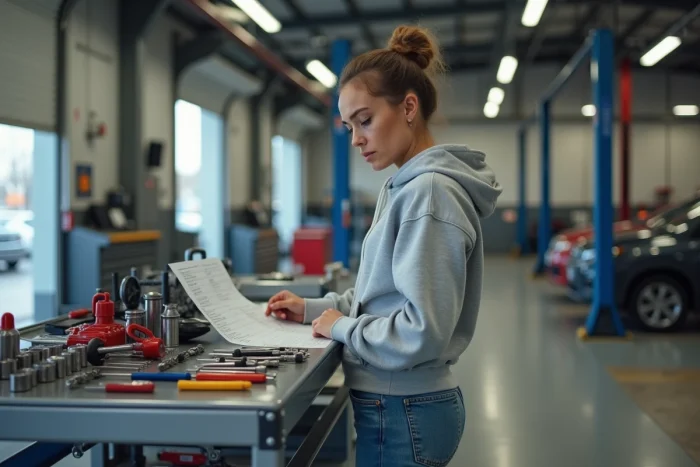
The two models coexist in Brittany, and confusion between them is common. An associative garage (also called a solidarity or participatory garage) relies on mixed funding: member contributions, local government subsidies, and sometimes resale of used vehicles. Access may be conditioned by social criteria.
A commercial self garage operates differently. The customer rents a lift, tools, and purchases their spare parts or consumables (filters, oil) on-site or elsewhere. No income conditions, no public subsidies. The rental price of a lift constitutes the main revenue.
Criteria for choosing between the two formulas
- Technical support: associative structures often employ one or two mechanic facilitators who guide the user step by step, while commercial garages allow for more autonomy
- Pricing: the associative garage offers lower rates thanks to public aid but may restrict access to certain groups (youth, job seekers, recipients of social minimums)
- Availability of slots: commercial structures generally offer wider time slots, including Saturdays, while associative workshops operate on limited schedules
- Types of permitted interventions: in both cases, operations on air conditioning or advanced electronics are often excluded from self-service
In Lorient, the first solidarity self garage attracted several hundred members within a few months of existence, providing elevating platforms, a pit, and professional tools. This rapid success illustrates the local demand for accessible automotive maintenance.
Third places for mechanics: the social dimension of Breton self garages
Reducing the self garage to a means of saving on auto maintenance ignores part of the phenomenon. Several recent structures in Brittany, particularly in the Lorient agglomeration, combine shared mechanical workshops with support for social integration.
The target audience goes beyond the simple motorist concerned about their budget. Popular education associations use these workshops as a lever for empowerment for people in precarious situations. Learning to diagnose a breakdown, replace an air filter, or check the wear of brake discs becomes a pretext for recreating social ties and developing transferable skills.
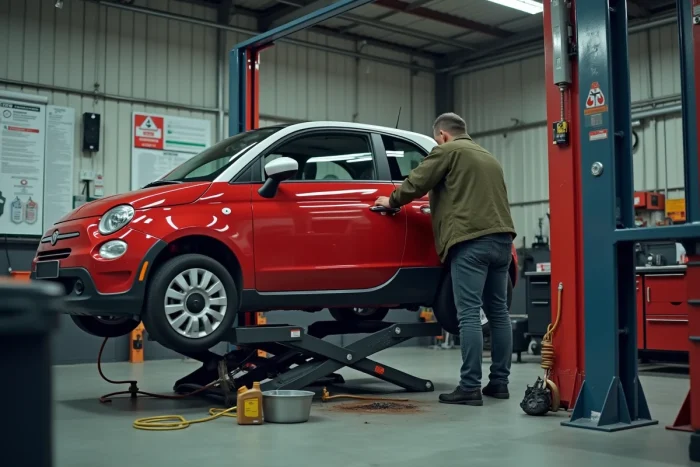
This positioning as a third place for mechanics forces structures to organize their workshops differently. Sessions are supervised, groups are limited, and the focus is on pedagogy rather than vehicle throughput. For an autonomous user who simply wants to access a lift on Saturday morning, this is not the right door. For someone looking to acquire solid foundations while paying less for their automotive maintenance, this format is particularly suitable.
Spare parts and consumables in self garage: points of vigilance
Renting a lift and having tools only solves part of the equation. The choice of spare parts and fluids remains the user’s responsibility, and this is where mistakes can be costly.
Some self garages offer a stock of common consumables (filters, oils, brake pads) directly on-site. Others allow the customer to bring their own parts. In both cases, the compatibility of the part with the vehicle is the user’s responsibility.
- Check the manufacturer’s reference for each part before purchase, not just the compatibility claimed by the online seller
- Follow the recommendations in the maintenance booklet for fluids (oil viscosity, type of coolant), or risk compromising the manufacturer’s warranty
- Always keep invoices for parts and self garage rentals to justify maintenance to an insurer or when reselling the vehicle
Regarding the manufacturer’s warranty, maintenance performed in a self garage does not automatically void it, provided that the recommended maintenance plan is followed and equivalent quality parts are used. Invoices are the only admissible proof in case of dispute.
The network of self garages in Brittany is expanding each year, driven by both the demand from motorists and local integration policies. Whether the choice is for an associative structure in Lorient or a commercial workshop in Rennes, the financial gain on routine maintenance remains the common denominator, as long as one accurately assesses their skill level before sliding under the vehicle.