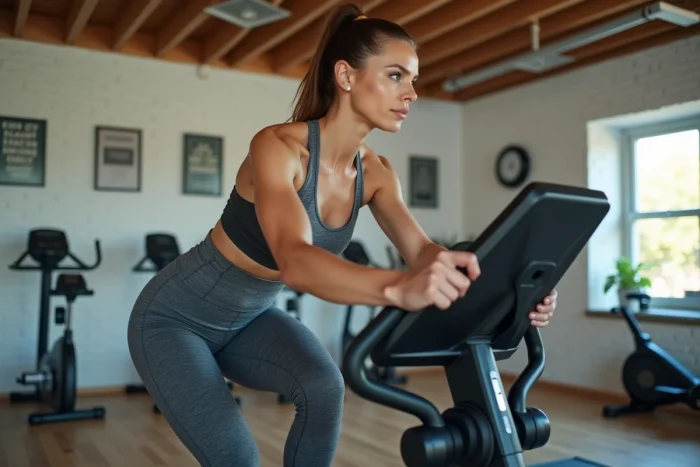
The cadence displayed on an elliptical bike console is meaningless without context. The same number in rpm can correspond to an active recovery session or a lactic effort depending on the resistance applied, the incline of the stride plane, and the user’s build. We will detail the parameters that truly determine the choice of a relevant rpm range.
Incline and stride kinematics: the parameter that the console ignores
On a fixed incline elliptical, the comfortable cadence of a given user remains relatively stable from one session to another. Recent models with adjustable incline change the game: altering the angle of the pedal plane affects the kinematics of the stride, which shifts the spontaneous cadence downwards as the incline increases.
We observe that increasing the incline by a few degrees is enough to significantly reduce the “natural” cadence without decreasing the perceived effort. The classic mistake is to maintain the same rpm target regardless of the angle, which forces an inappropriate pedaling frequency and generates unnecessary joint stress at the knee.
When working on a variable incline elliptical, we recommend defining the optimal speed in rpm for elliptical bikes based on each incline position, rather than as a universal value applied to all your sessions.
Self-selected cadence vs imposed cadence on elliptical bike
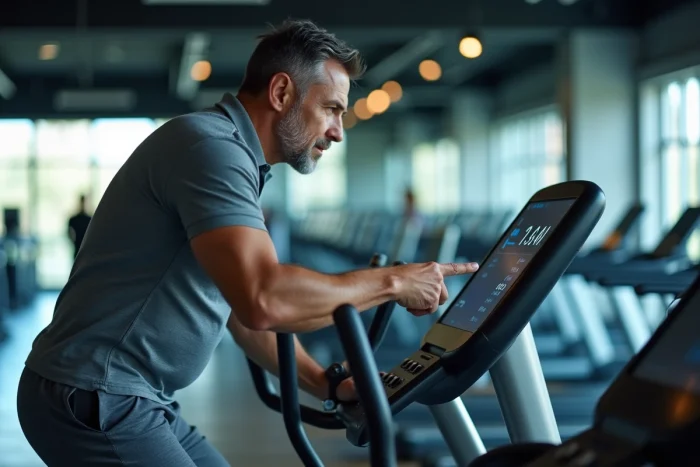
The trend among manufacturers and fitness clubs is towards self-selected cadence. The principle: allow the user to spontaneously find their pedaling speed, then only adjust the resistance to maintain the correct heart rate zone. Studies in sports ergonomics show that a freely chosen cadence is more energy-efficient and better tolerated than an identical cadence imposed on all body types.
In practice, two people of different builds on the same machine will not have the same optimal cadence, even at the same heart rate. A tall user with long femoral segments naturally pedals more slowly than a compact user. Forcing a single cadence for all profiles degrades mechanical efficiency and increases the perception of effort.
How to utilize self-selected cadence
Start each session with a few minutes at moderate resistance without looking at the console. Note the cadence at which you stabilize: this is your reference rpm for this incline position and level of fatigue. Then adjust the resistance to reach your target heart rate zone without intentionally changing the cadence.
This approach assumes a reliable heart rate monitor, ideally a chest strap rather than a wrist optical sensor, whose latency distorts real-time control.
RPM zones and training session programming
The consoles of recent connected ellipticals segment effort into distinct cadence zones, calibrated from simplified threshold tests. Instead of displaying a single recommended rpm value, these programs define at least two ranges:
- A fundamental endurance zone, at a moderate but maintainable cadence over long sessions, where the heart rate remains stable well below the ventilatory threshold.
- A high-intensity zone (like HIIT), at a faster cadence held over short intervals, combined with increased resistance to engage the anaerobic pathway.
- An active recovery zone, at free cadence and minimal resistance, used between intervals or at the end of a session to accelerate the return to calm.
Some models, particularly those compatible with platforms like iFit at NordicTrack, go further: the console cross-references your heart rate in real-time with an estimate of your VO2max to suggest a personalized rpm range for each phase of the training.
Calibrating your zones with a threshold test
High-end ellipticals offer progressive ramp tests (a few minutes of increasing effort) to estimate your ventilatory threshold. The result is then used to set the limits of your cadence zones. Without this calibration, the ranges displayed by the console remain generic and less usable.
If your machine does not offer this type of test, a simple alternative exists: increase the resistance in regular increments while maintaining a constant cadence. The point at which you can no longer maintain the cadence without marked breathlessness approximately corresponds to your threshold. Your endurance rpm is clearly below this point.
Resistance and flywheel weight: the other half of the rpm equation
Talking about rpm without mentioning resistance is like measuring the speed of a vehicle without knowing the engaged gear ratio. Cadence only has physiological value when coupled with the level of resistance. On an elliptical with a light flywheel, a high cadence may correspond to modest cardiovascular effort. On a model with a heavy flywheel (over a dozen kilos), the same cadence generates significantly greater muscular and cardiac work.
The type of braking also plays a role. A motorized magnetic braking system offers linear and reproducible resistance from one session to another, making your rpm data comparable over time. Mechanical pad braking, on the other hand, varies with wear and temperature, making any longitudinal comparison risky.
Adjusting resistance to the session’s goal
For a session focused on weight loss and endurance, we recommend prioritizing moderate resistance that allows you to maintain the chosen cadence throughout the entire session without dropping out. For muscular power work, increase the resistance and accept a lower cadence: the mechanical stimulus on the quadriceps and glutes will be more pronounced.
- Long session (endurance, calories): moderate resistance, stable self-selected cadence, heart rate in the aerobic zone.
- HIIT session (intensity, VO2max): alternating phases of high resistance and reduced cadence with sprint phases at lighter resistance and high cadence.
- Recovery session: minimal resistance, free cadence, short duration.
The rpm displayed on your console is not a goal in itself. It is an indicator that only makes sense when cross-referenced with resistance, incline, and your heart response. A training structured around cadence zones calibrated to your own threshold will always yield better results than a race for revolutions per minute.