Getting a sofa, a dresser, or a table without spending a dime is a reality accessible if you know where to look. Free furniture circulates among individuals every day, supported by donation platforms, neighborhood groups, and still-unknown grassroots practices.
Buy Nothing Neighborhood Groups: Free Furniture Just a Few Streets Away
You may know the major donation platforms like Geev or Donnons. Their geographical reach often covers an entire city, sometimes a department. The Buy Nothing movement works differently: each group is limited to a specific neighborhood, sometimes just a few streets.
The principle is simple. A neighbor posts a photo of a piece of furniture they want to get rid of. Group members, all geographically close, can pick it up on foot or by bike. No delivery fees, no price negotiations since everything is free.
These groups have grown significantly in French-speaking Europe since 2023, particularly in France, Belgium, and Switzerland. They operate via Facebook or through the official BuyNothing app, relaunched the same year. For those looking to find free furniture from individuals, these hyperlocal groups often represent a quicker option than large online listings.
Why does this proximity change the game? Because a bulky piece of furniture, like a sideboard or a bed, can be picked up without a van. The giver and the receiver live in the same area, which minimizes logistics to the strict minimum.
Resource Centers and Recycling Centers: Free Spaces That Go Unmonitored
French resource centers and recycling centers collect items to resell them at low prices after refurbishment. What many don’t know is that some of the collected furniture never makes it to the shop.
Some pieces of furniture that are too bulky or difficult to sell are left for free pickup. The National Resource Network documents the existence of free spaces integrated into certain structures. These areas, sometimes located at the entrance of the site or near the bins, allow anyone to leave with a piece of furniture without any formalities.
The practice varies from one structure to another. Here are a few concrete tips to take advantage of it:
- Call the nearest resource center and ask if they have a free drop-off area or open pickup hours
- Visit at the end of the day or on collection days, when the arrivals are the freshest and sorting is not yet complete
- Favor structures in suburban areas, where the volumes of collected furniture are often larger than in city centers
This approach requires a bit of regularity. Interesting pieces go quickly, but the foot traffic in these spaces remains low compared to online platforms, which leaves real opportunities.
Online Donation Platforms: Setting Up Alerts on Geev and Donnons
Geev and Donnons remain the two reference platforms for object donations between individuals in France. On Geev, the furniture category generates a constant flow of listings with several hundred thousand new items published each month across all categories.
Why Good Furniture Disappears in a Few Hours
A sofa in good condition posted in the morning will be reserved before noon. Reactivity is the decisive factor on these platforms, not the politeness of the message or the length of the profile. Users who regularly pick up nice pieces all have the same reflex: alerts activated by category and geographic area.
On Geev, set an alert in the “Furniture” category with a narrow radius around your address. On Donnons, check the “Furniture” section sorted by date. In both cases, respond within minutes of publication.
Writing a Request That Gets a Response
Givers sometimes receive dozens of messages in an hour. An effective message consists of two sentences: who you are (first name, neighborhood) and when you can come to pick up the furniture. Offering a specific pickup time doubles your chances of being chosen.

Dumpsters and Sidewalks: Legally Picking Up Abandoned Furniture
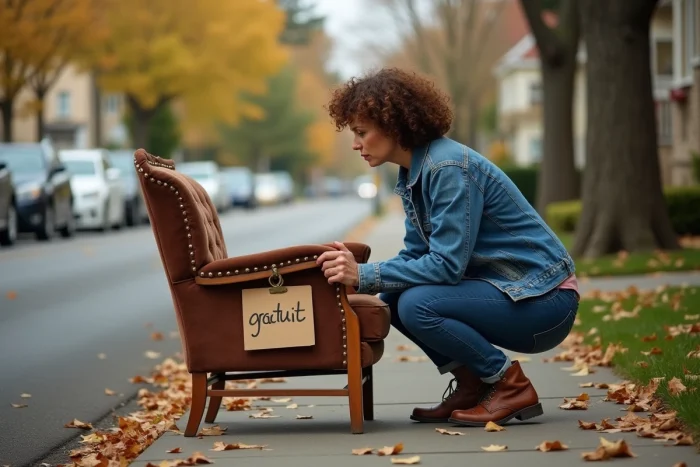
Have you ever noticed a piece of furniture placed on a sidewalk with a “free” sign? This practice, common in large cities, constitutes a legitimate recovery channel. A piece of furniture left on public property with a clear intention of donation can be picked up freely.
Scheduled bulky waste collection days by the community are a strategic moment. Go the night before or early in the morning on collection day to spot interesting pieces before the truck arrives.
Regarding dumpsters, the situation depends on the internal regulations of each site. Some allow the recovery of deposited items, while others strictly prohibit it. A quick question at the reception is enough to clarify the local rules.
Here are a few precautions to keep in mind:
- Check the structural condition of the furniture before loading it, especially the table legs, hinges, and drawer bottoms
- Avoid mattresses and upholstered furniture picked up outdoors, as they may have absorbed moisture or harbor pests
- For solid wood furniture, a simple sanding and a coat of varnish are enough to restore a decent appearance
Furniture recovered outdoors requires careful examination, but a free solid wood piece is often better than a new particle board piece. The durability of the material more than compensates for superficial signs of wear.
Finding free furniture near you relies less on luck than on method. Neighborhood groups, free spaces in resource centers, well-set alerts on donation platforms, and rounds before bulky waste collections: each channel has its rhythm and habits to adopt. The first piece of furniture picked up for free is often the hardest to find. The next ones come almost naturally.