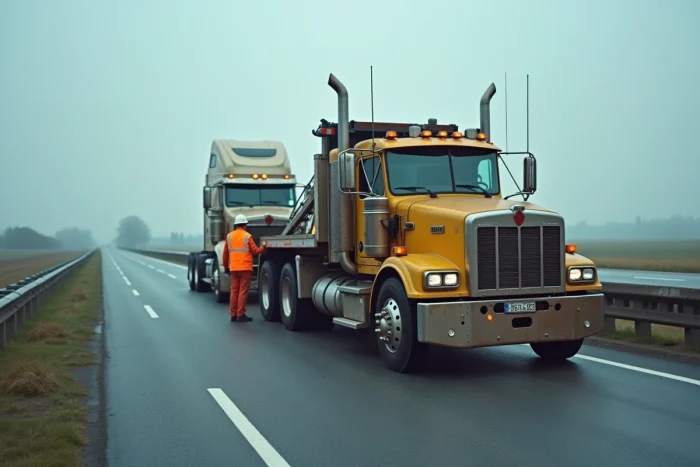
Towing a heavy vehicle stranded on a highway is not managed the same way as that of a light vehicle. The mass involved (up to several tens of tons), the configuration of the load, and the marking constraints impose specific protocols, equipment, and response times. We have observed an accelerated structuring of the sector in France over the past few years, driven by the contractual requirements of carriers and the digitalization of assistance platforms.
High Voltage Constraints and CNG: Towing in the Face of New Engine Types
The rise of CNG, bioCNG, HVO, and electric trucks redistributes the skills required from heavy-duty tow truck operators. An electric or high-voltage hybrid vehicle cannot be winched without specific authorization: the risk of electric arc or coolant leakage requires safety measures that are absent from traditional training.
Some fleet managers notice an extension of intervention times when the tow truck operator mobilized is not certified for these engine types. We recommend checking, before any contractual agreement, that the provider has a high voltage and CNG certification, otherwise the promised speed on paper will remain theoretical.
This point becomes critical on routes where the density of CNG stations or charging points for heavy vehicles is increasing: the likelihood of a breakdown related to alternative engines rises, and the network of competent tow truck operators is not yet widespread. Fleets exploring heavy-duty towing solutions in France adapted to these engines gain a measurable operational advantage in their downtime.
SLA and Late Penalties: What Framework Contracts Change for Heavy-Duty Towing
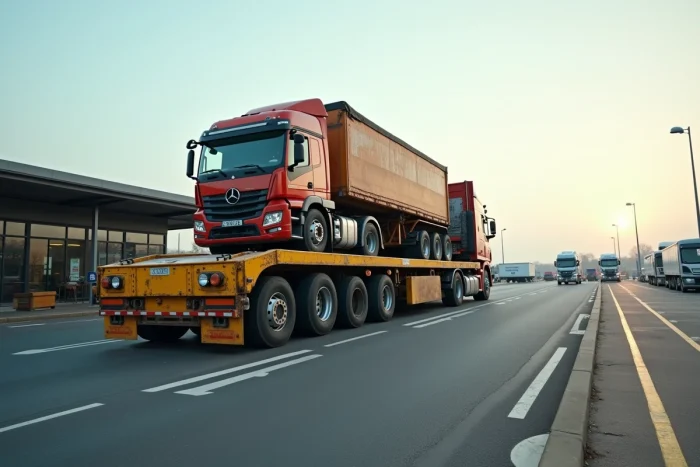
In recent years, major road transport groups have integrated precise SLAs with heavy-duty tow truck operators into their framework contracts. The principle: a guaranteed intervention time, accompanied by financial penalties in case of overruns.
This mechanism raises the average speed of arrival on site, particularly on major highways. For the client, the interest goes beyond comfort: every hour of immobilization of a loaded truck generates cascading costs (delivery delays, logistical overruns, contractual penalties from the end customer).
Criteria to Require in a Heavy-Duty Towing Contract
- A maximum intervention time expressed in minutes, differentiated by area (highway, national road, dense urban area) and documented by GPS timestamp upon arrival on site
- A degressive penalty clause that automatically applies beyond the guaranteed time, with no possibility of contestation from the provider
- A verified geographical coverage commitment: number of operational bases, effective range of each base, and availability rate of heavy tow trucks (flatbed, lifting crane, suitable winches)
- A real-time information escalation procedure to the client, ideally via a shared digital platform
An SLA without penalties is merely a statement of intent. We observe that carriers negotiating concrete penalties achieve significantly shorter response times.
Geolocation and Connected Charging Stations: The Location Phase is No Longer the Bottleneck
Locating the stranded vehicle has long been the most time-consuming step in a heavy-duty intervention. On the highway, a stressed driver indicating “between exit 12 and exit 13, right side” was not enough to position a tow truck accurately.
Highway companies (APRR, VINCI Autoroutes) are now generalizing the use of connected charging stations and automatic geolocation to trigger heavy-duty interventions. The gain is in the first few minutes, when dispatch identifies the nearest base and confirms the availability of a suitable crew.
On the assistance side (Allianz Partners, Europ Assistance, AXA), digital platforms centralize calls, geolocation, choice of tow truck operator, and real-time tracking. This technological layer improves the overall speed of response but imposes digital equipment and data reporting requirements on heavy-duty tow truck operators, effectively excluding the least equipped structures.
Equipment of Heavy Tow Trucks: Flatbeds, Winches, and Lifting
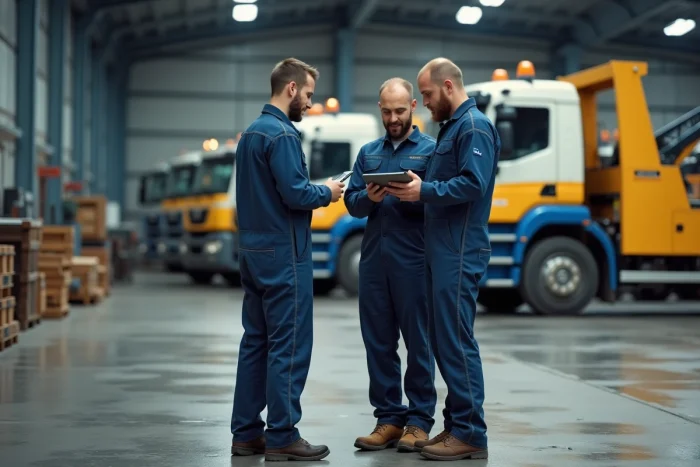
The ability of a provider to effectively handle an intervention directly depends on its equipment fleet. Towing a loaded semi-trailer does not mobilize the same resources as a breakdown of an empty truck.
Critical Equipment for a Quick Heavy-Duty Intervention
- A flatbed tow truck capable of loading the complete vehicle, suitable for the GVW of the heavy vehicle in question
- High-capacity hydraulic winches to extract a stuck or accident-damaged truck from the roadway without damaging the chassis
- A lifting arm or auxiliary crane for partial overturn situations, common on highway ramps and roundabouts
- A regulatory marking kit and temporary signaling equipment to secure the intervention area, especially at night
The market for used heavy-duty tow trucks remains active in France, but a poorly maintained intervention vehicle slows down the rescue chain. We recommend that carriers ask for the average age of the fleet and the technical inspection certificates of the tow trucks assigned to their contract.
Punctures and Mechanical Failures on Site: Repair Rather Than Tow
A significant portion of heavy-duty interventions involves punctures or mechanical failures that can be repaired on-site (battery, pneumatic circuit, hydraulic hose). A provider capable of dispatching a mobile workshop drastically reduces immobilization time compared to systematic towing to a garage.
This selection criterion is often overlooked. A tow truck operator who only offers towing to a workshop for a simple puncture doubles the vehicle’s downtime and unnecessarily mobilizes a heavy flatbed.
The heavy-duty towing sector in France is professionalizing under the combined pressure of contractual SLAs, energy transition, and the digitalization of assistance services. Carriers who select their providers based on verifiable technical criteria (certifications for alternative engines, documented equipment fleet, mobile intervention capability) significantly reduce their immobilization times, whereas a choice based solely on hourly rates exposes them to logistical costs far exceeding the initial savings.