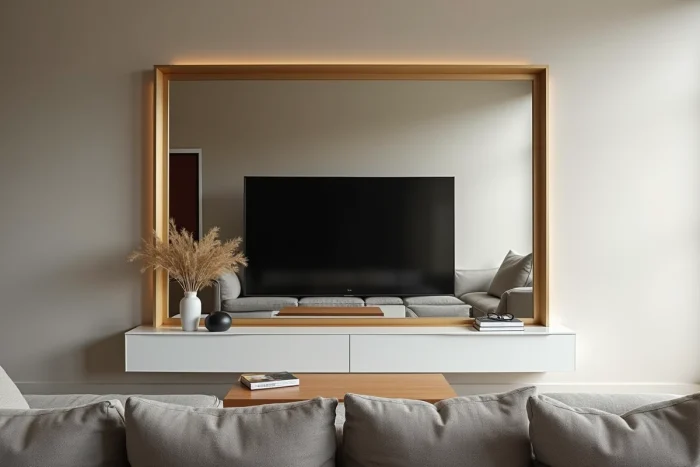
A wall mirror in a living room alters the perception of space, the flow of light, and the overall ambiance of the room. When this mirror is positioned opposite a television, the effects change in nature. The reflection of a lit screen generates a double source of moving images, with implications for visual comfort that go beyond mere decorative concerns.
Unwanted reflections and visual fatigue: what a mirror facing a screen produces
A television emits direct, changing, often intense light. Positioned opposite a mirror, this light flow is reflected back into the room. The brain then processes two sources of moving images simultaneously, even when the gaze remains fixed on the screen.
For individuals prone to migraines or visual hypersensitivity, this multiplication of light stimuli can accelerate eye fatigue. A mirror facing the television doubles the light stimulation in the living room, especially in the evening when the contrast between the screen and the rest of the room is pronounced.
The type of ambient lighting plays a crucial role. According to the Futura guide dedicated to lighted mirrors, frontal and diffuse lighting limits unwanted reflections on shiny surfaces, including screens. A single ceiling light or directional ceiling spots, on the other hand, accentuate light reflections in the mirror.
Before deciding to place a mirror opposite the television, checking the orientation of the living room’s light sources remains a step often overlooked.
Mirror and television: the effect on the content being watched
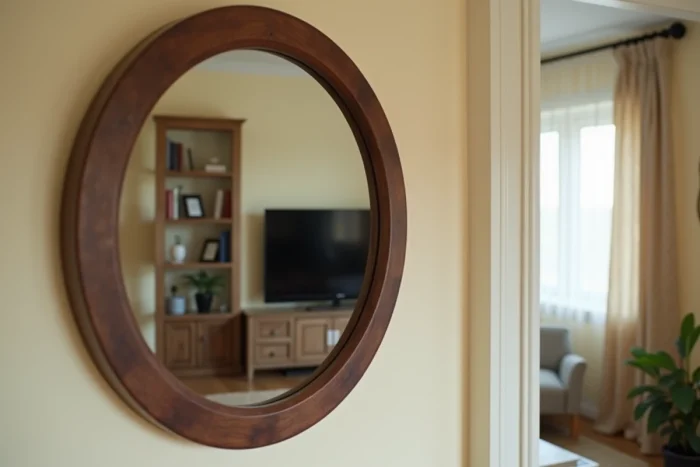
The content broadcast on the screen is not neutral in this configuration. An action movie with quick cuts or a news broadcast with anxiety-inducing images is visually amplified by the mirror. In the tradition of feng shui, this phenomenon is described as an amplification of the visual energy of the content, which amounts to saturating the room with stimulation that the viewer did not choose.
This point also applies to modern living rooms already filled with reflective surfaces. Between windows, glossy furniture, computer screens, and a large mirror, the living room becomes a space of permanent visual overload. Adding a mirror facing the television in this context amplifies an already existing problem.
The case of calm programs
With a documentary, a screensaver, or a music broadcast, the mirror facing the television poses fewer problems. The reflection remains stable, and the brightness varies little. The decorative effect of enlarging the room can then work without any bothersome drawbacks. The question of well-being thus depends as much on the mirror itself as on the actual use of the television.
Quality of the mirror and distortion of the reflected image
A low-quality mirror with thin or irregular glass slightly distorts the images it reflects. Facing a television, this distortion creates a blurry, wavy reflection that tires the eyes more quickly than a sharp reflection. A low-quality mirror exacerbates all the disadvantages of this configuration.
Field reports vary on this point: some decorators believe that a well-made mirror, with thick glass and anti-reflective treatment, sufficiently reduces the problem to make the arrangement acceptable. Others argue that even a high-end mirror does not compensate for the discomfort related to the constant movement in the peripheral field of vision.
Here are a few criteria to check before installation:
- The thickness of the glass: a thin mirror reflects a less stable image than a model with thick glass, which increases visual fatigue when facing a moving screen.
- The size of the mirror relative to the screen: a mirror larger than the television captures more peripheral attention, while a smaller model limits the reflection to a restricted area.
- The angle of inclination: a mirror slightly tilted up or down shifts the reflection of the screen out of the direct line of sight of the viewer sitting on the couch.
Alternatives to the classic mirror facing the television
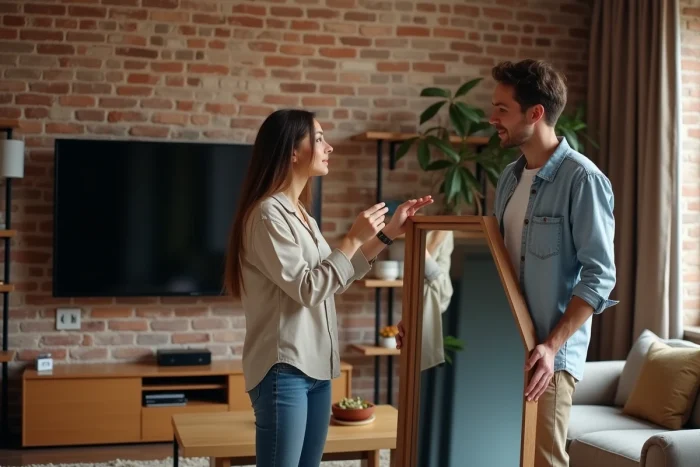
The market has recently introduced televisions integrated into a mirror. When the device is off, the surface resembles a classic decorative mirror. When turned on, the screen appears through the glass. This solution eliminates the issue of double reflection since the mirror and screen form a single object. High-end hospitality adopts this type of product for its rooms and bathrooms, indicating the maturity of the technology.
For those who wish to keep a classic mirror on the wall without sacrificing decoration:
- Shifting the mirror a few dozen centimeters to the side of the wall, out of the direct axis of the television, often suffices to eliminate the reflection of the screen without losing the room enlargement effect.
- Placing the mirror on an adjacent wall rather than directly opposite, perpendicular to the television, allows it to capture natural light from the window without reflecting the image of the screen.
- Choosing a mirror with a thick, dark frame that reduces the reflective surface and mitigates the perception of the television reflection.
The role of wall installation
The height of hanging also changes the game. A mirror positioned higher than the screen captures the reflection of the ceiling rather than that of the television. Lower down, it reflects the floor or the TV unit. Only a mirror exactly at the same height as the screen reflects the image directly into the viewer’s line of sight.
The ideal configuration of the living room depends on the size of the room, the orientation of the windows, and the type of lighting installed. The available data does not allow for a universal rule. A mirror facing the television may work in a large, well-lit living room with diffuse light, and become a real source of discomfort in a small space with spot lighting. The decision is made room by room, testing the position before drilling the wall.