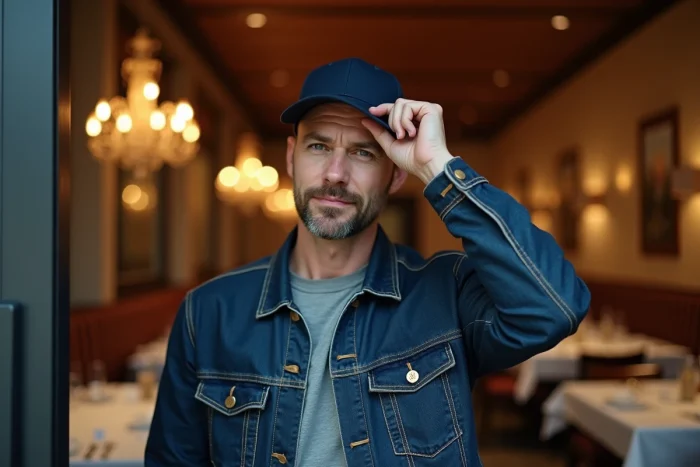
The cap worn indoors still provokes reactions, from the pointed gaze of an elder to the school regulations displayed at the entrance. Does removing one’s cap indoors stem from a fixed cultural reflex or a norm that is still measured in current practices? Recent data on dress codes in companies and diversity policies allow us to pose the question differently, far from a simple historical reminder.
Cap at work: what internal regulations say according to company size
| Type of structure | Explicit rule on headgear | Observed trend |
|---|---|---|
| Companies with fewer than 50 employees | Mostly absent | No formal guidelines in most cases |
| Large companies and administrations | Frequently maintained | Rules still common, often related to image or safety |
| Start-ups and open spaces | Rarely mentioned | Wide tolerance, including for caps |
This table is based on the ANACT report published in November 2023, titled “Dress Codes at Work in the Age of Telecommuting.” The finding is clear: the “no cap” rule is declining in smaller structures, while it persists in larger or institutional organizations.
The gap is not coincidental. Large companies manage face-to-face client relationships, security protocols, or visual identification constraints. Smaller structures, on the other hand, operate more on interpersonal trust, and headgear does not pose a functional problem there.
Those who wonder why to remove one’s cap indoors will find in this distribution a first answer: the norm depends less on a universal principle than on the specific professional context.

Distinction between style cap and functional headgear: the French legal framework
One point that most articles on etiquette overlook: the question of headgear indoors is no longer just about politeness. It now touches on the law.
The “Guide to Secularity in Private Companies,” updated by the Defender of Rights in 2023, sets a clear framework. A company cannot prohibit all headgear in general if this prohibition indirectly targets religious reasons, unless justified by the nature of the task or safety.
This forces employers to rephrase their internal regulations. Instead of writing “no hats or caps,” they must specify the functional reasons for the prohibition:
- Food hygiene in collective kitchens or laboratories, where only hairnets or caps are allowed
- Visual identification in reception or security positions, where the face must remain visible
- Physical safety on construction sites, where helmets replace any other headgear
Outside of these cases, the prohibition of a cap worn for style has no solid legal basis in the private sector. The boundary between social etiquette and enforceable rules thus shifts towards objective criteria.
Cap indoors and social perception: where the norm remains active
The decline of formal rules does not mean that perception has changed everywhere. Some spaces still maintain a strong expectation, and wearing a cap in these places still provokes measurable social judgment.
Places of worship and official ceremonies
In churches, synagogues (excluding kippahs), and during civil ceremonies, removing one’s headgear remains an expected gesture by almost all participants. The gesture marks the transition from a public space to a symbolic space, and its transgression is perceived as a lack of respect towards the assembly, not just towards an abstract tradition.
Gourmet restaurants and formal events
High-end establishments often maintain a tacit expectation. No sign indicates this, but staff may make a discreet request. In contrast, in brasseries, cafes, and fast-food restaurants, wearing a cap has long posed no problem.
Educational institutions
The internal regulations of French middle and high schools frequently prohibit headgear in class. The justification given relates to the identification of students and respect for the collective framework. School remains the last space where the rule is applied without nuance of age or context.

Reformulating the rule: concrete criteria for deciding whether to keep or remove one’s cap
Rather than an automatic reflex, the decision can rely on a simple framework. Three questions are sufficient:
- Does the place have symbolic significance (place of worship, ceremony, court)? If so, removing the cap remains the dominant social norm
- Does the internal regulation mention a restriction related to hygiene, safety, or identification? If so, the rule has a functional basis and applies
- Is the context informal (open space office, café, home of close friends)? In this case, tolerance is largely established, especially among generations born after 1980
This framework reflects the evolution documented by ANACT and the Defender of Rights: the norm migrates from the principle of politeness to functional and contextual criteria.
The gesture of removing one’s cap indoors has not disappeared, but it has changed in nature. In spaces with strong symbolic significance, it remains a marker of shared respect. In the world of work and informal places, it now depends on local regulations and situational common sense. The real question is no longer “should one remove their cap?”, but “in what space and for what specific reason?”.