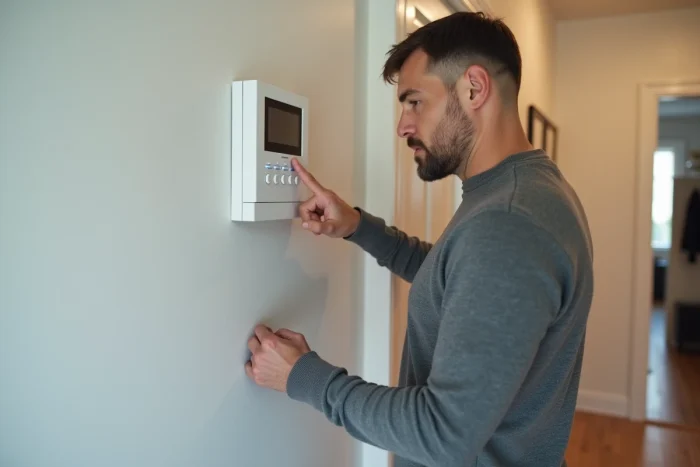
A burglar does not need to force a door if your alarm no longer communicates. Jammers, those small devices that drown out radio signals, have become the tool of choice for organized teams. Understanding how they work allows you to choose the right countermeasures and keep your Verisure system truly operational.
Multi-band jammer: the threat that most guides underestimate
Articles on home security often describe GSM jamming as an isolated risk. The reality on the ground is harsher. French and Spanish customs have been seizing portable jammers for several years that can simultaneously cover GSM 900/1800, 3G/4G, Wi-Fi 2.4 GHz, and sometimes the 433 MHz radio band.
In practical terms, a single device the size of a walkie-talkie can cut off all communication channels of a traditional alarm at once. These multi-band jammers are sold illegally on online marketplaces but remain accessible with just a few clicks.
Why does this detail change everything? Because an alarm that relies on a single transmission channel is vulnerable by default. Even a dual ADSL + GSM link can be neutralized if the jammer covers both relevant bands. To protect your Verisure alarm from jammers, you must understand that the countermeasure relies on multiplying communication paths, not on strengthening just one.
Verisure anti-jamming detection: how the control panel spots a jammer
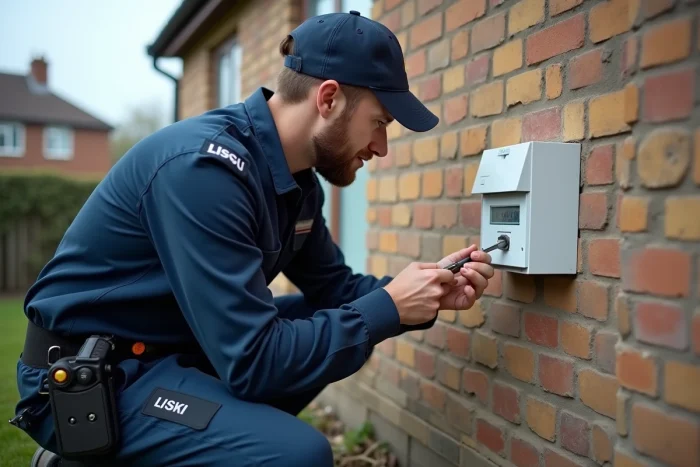
Your Verisure control panel continuously monitors the quality of the radio signal between it and each detector. When a jammer activates nearby, the noise level on the used frequencies rises sharply. The control panel identifies this anomaly and triggers a jamming alert.
This mechanism works a bit like a smoke detector, but for radio waves. Instead of detecting particles in the air, the control panel detects a “wall” of interference on its working frequencies.
What happens next
The alert is sent to the Verisure monitoring center, which can then initiate a verification (camera check, call to the home, contact with law enforcement). The jammer itself becomes the trigger for the intervention. A burglar attempting to neutralize the alarm provokes exactly the reaction they wanted to avoid.
Verisure also uses a backup network called ATN. When the main GSM channel is cut or saturated, the control panel switches to this backup network to maintain the connection with the monitoring center. This redundancy is the point that distinguishes a system connected to a monitoring center from a standalone alarm.
Anti-sabotage alarm: often overlooked physical protections
Jamming is just one method among others. Burglars may also try to rip a detector from the wall, cut the power supply, or sever a cable. Each Verisure sensor includes an anti-tampering device: if the case is detached from its mount, the alarm triggers immediately.
For power cuts, the control panel has a backup battery. In the event of a power outage, the system continues to operate and communicate with the monitoring center for several hours.
Here are the layers of protection that, combined, make sabotage significantly more difficult:
- Radio jamming detection with automatic alert to the monitoring center
- Switching to the ATN backup network when the GSM channel is disturbed or cut
- Anti-tampering function on each sensor and on the control panel itself
- Backup battery that keeps the system active in case of power failure
Radio frequencies and protocols: why not all alarms are equal against jamming
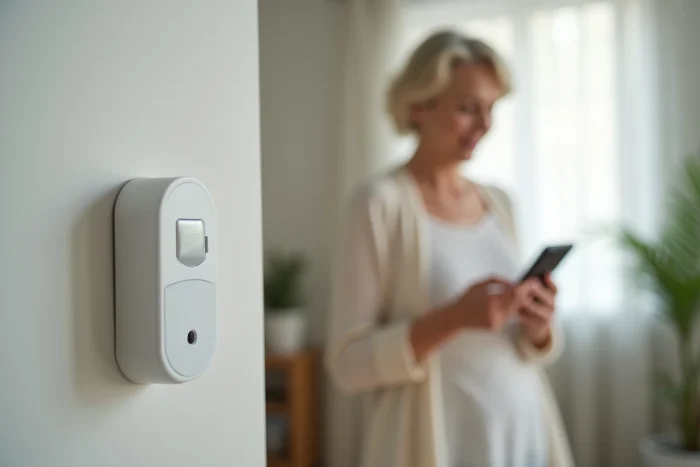
Home alarms primarily communicate on two bands: 433 MHz and 868 MHz. The 868 MHz band, used by Verisure and other professional systems, offers an advantage: it is less crowded and more resistant to common interference.
Cheap jammers often target the 433 MHz band, which is very common in entry-level systems (gates, shutters, basic alarms). A system operating on 868 MHz with an encrypted communication protocol and frequency hopping makes it significantly more difficult for a standard jammer.
The LTE-M and NB-IoT track
Professional manufacturers (Honeywell/Resideo, Hikvision) are now integrating LTE-M or NB-IoT modules into their control panels. These low-power cellular protocols are less sensitive to jammers designed for traditional GSM and 4G. The reason: they use different frequency bands and modulation modes.
This evolution represents the next step for home security systems. A system equipped with a triple communication path (wired IP, GSM/4G, and LTE-M) becomes extremely difficult to neutralize simultaneously.
Installation reflexes to strengthen anti-jamming protection
Equipment is not everything. The location of the control panel and detectors plays a direct role in resistance to jamming.
- Place the control panel in a discreet and hard-to-access location, away from openings (a jammer loses effectiveness with distance and obstacles)
- Check that the control panel properly receives the cellular network at its location to ensure a quick switch in case of disturbance
- Do not disable periodic test notifications: they confirm that each sensor is communicating normally with the control panel
A jammer must be close to the control panel to be effective. The further the control panel is from the facade and windows, the closer the burglar must approach the building with a powerful device, which increases the risk of being spotted.
Using a jammer is a crime in France. This legal prohibition does not deter organized teams, but it allows law enforcement to add an additional offense to prosecutions. The best protection remains a system with multiple communication channels, connected to a monitoring center capable of reacting as soon as a jamming attempt is detected.