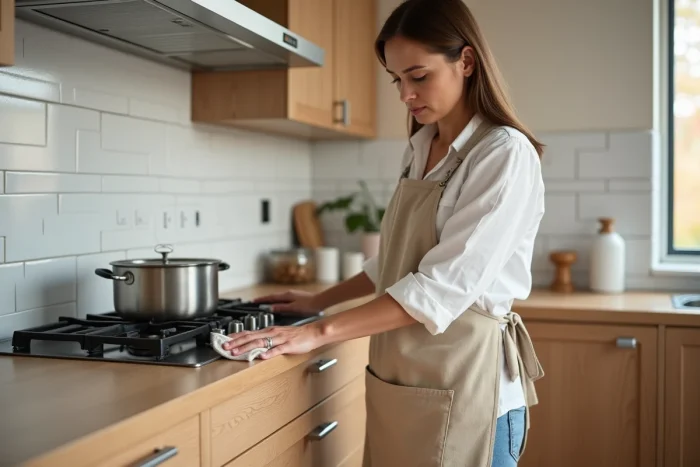
The steam released by a cooking hob, a kettle, or a dishwasher upon opening rises directly towards the upper cabinets. After a few months, this repeated exposure to moisture and condensation deforms the panels, detaches the edges, and encourages the growth of mold on the interior surfaces of the cabinets. Protecting your kitchen furniture from steam requires action on several fronts simultaneously: the material itself, the room’s ventilation, and the management of steam sources.
Condensation under upper cabinets: a mechanism often misidentified
The hot water vapor that rises during cooking comes into contact with the cooler underside of the upper cabinet. This temperature differential causes condensation, just like on a window in winter. The water droplets that form do not always evaporate before the next use.
This phenomenon is more pronounced with recirculating hoods (charcoal filter) than with extraction hoods. In recirculation mode, the moisture-laden air remains in the room instead of being expelled outside. Installation manuals from manufacturers like Bosch or Siemens (2023-2024 editions) now mention minimum distances between the cooking surface and the cabinets, not only for heat but to reduce the impact of steam on the cabinets.
The placement of the kettle poses a similar problem. Positioned under a cupboard, it directs a concentrated jet of steam onto a small area of the lower panel, which accelerates localized swelling of the wood or melamine. Moving the kettle out of alignment with a cabinet is the simplest and most effective measure to ensure durable steam protection for kitchen furniture.
Facade materials and steam resistance in the kitchen
Not all panels react the same way to moisture. Standard particle board (chipboard) absorbs water quickly as soon as the edge or surface is damaged. MDF is slightly more resistant but remains vulnerable if the finish is scratched or chipped.
Since 2022, several kitchen manufacturers have standardized facades made of high-density melamine and HPL laminate specifically tested for steam resistance. Ikea, with its Voxtorp and Kungsbacka ranges (technical sheets 2023), as well as Nolte Küchen and Nobilia, document accelerated aging tests according to EN 316 and EN 438 standards. This development often goes unnoticed by the general public, but it changes the game for furniture located above a cooking area.
Check the condition of the edges and joints
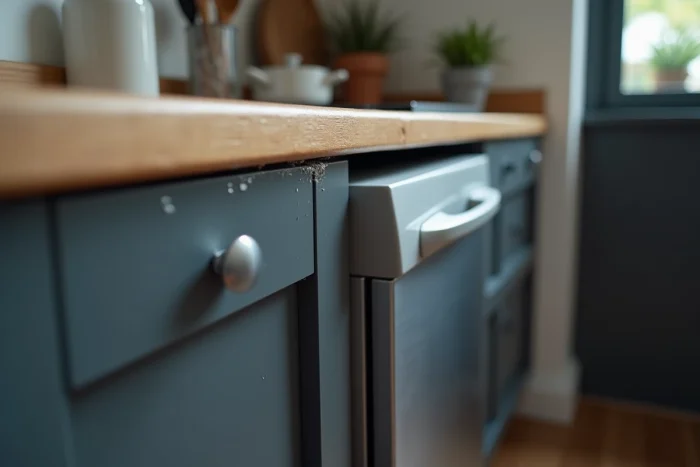
The weak point of a particle board cabinet is the edge. A detached edge, even by a few millimeters, allows moisture to penetrate the panel. The resulting swelling is irreversible. Running a finger along the lower edges of the upper cabinets helps identify detachments before they worsen.
Field reports vary on the durability of thin PVC edges compared to thicker ABS edges. What is certain is that a quickly re-glued edge with polyurethane glue limits infiltrations and extends the life of the cabinet by several years.
Ventilation and extraction: the role of the VMC and the hood
A well-chosen kitchen cabinet is not enough if the ventilation is inadequate. Condensation on surfaces directly depends on the ambient humidity level and air renewal.
- A single-flow VMC in good condition continuously evacuates humid air from the kitchen. If the extraction vent is clogged or undersized, humidity stagnates and settles on the cabinets, walls, and ceiling.
- An external extraction hood remains the most effective solution for capturing cooking steam at the source. It directly expels moisture-laden air outside the home.
- In the absence of an external outlet, a recirculating hood with an active charcoal filter retains odors and grease but does not reduce the humidity level in the room. Compensating with manual ventilation or an efficient VMC is then necessary.
Opening the window during and after cooking remains an underestimated gesture. A few minutes are enough to lower the humidity level in the kitchen and limit condensation on the cabinets.
Surface treatments to protect wood and panels
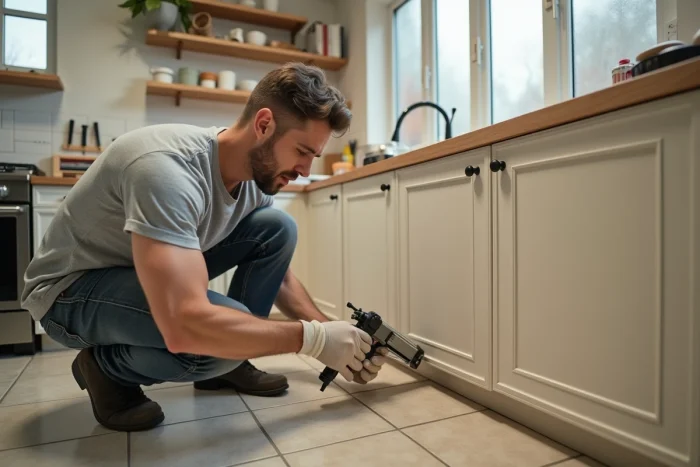
When the cabinets are already installed, applying a surface treatment to exposed areas provides an additional barrier against water.
Oil or varnish: two different logics
Wood oil penetrates the fibers and makes the material hydrophobic from the inside. It requires regular renewal (every one to three years depending on exposure). Varnish, on the other hand, forms a waterproof film on the surface. It protects longer without maintenance, but a chip in the film allows water to infiltrate under the protective layer, which can cause blistering.
For the underside of an upper cabinet located above a cooking hob, matte polyurethane varnish offers the best resistance to repeated steam. Oil is better suited for surfaces that can be easily maintained, such as countertops.
Protecting unfinished melamine panels
The interior of the cabinets and the underside of the upper cabinets are often made of raw panel or with a thin melamine coating. Applying a coat of bonding varnish or a waterproof primer on these bare surfaces limits moisture absorption. The cost is modest, and the operation requires only a brush and an afternoon.
Daily gestures that reduce exposure to steam
Beyond treatments and ventilation, a few cooking habits significantly change the amount of steam that reaches the cabinets:
- Using lids on pots drastically reduces the steam released into the kitchen air.
- Turning on the hood before starting to heat, not after the steam has already risen towards the cabinets.
- Cracking open the dishwasher door at the end of the cycle, on the side opposite the cabinets, so that the steam dissipates away from the cabinets.
These adjustments cost nothing and mechanically reduce the humidity load to which the cabinets are subjected daily.
Protecting kitchen furniture from steam relies on a combination of factors: facade materials suited to exposure, effective air extraction, surface treatments on vulnerable areas, and cooking gestures that limit steam at the source. None of these levers is sufficient alone, but their combination tangibly extends the lifespan of the cabinets and facades.