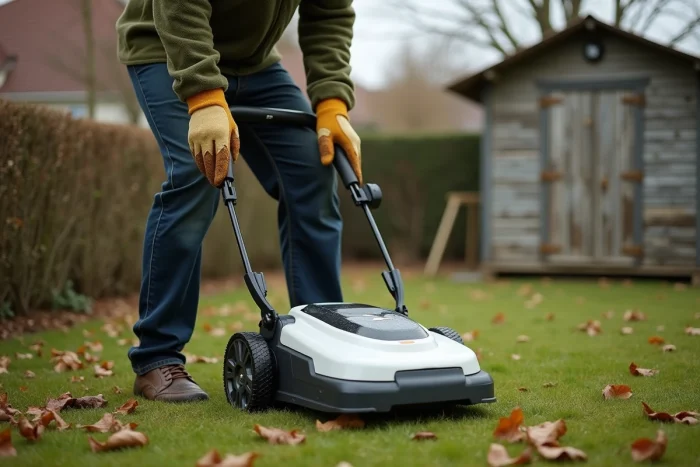
A poorly winterized robotic mower does not break down on the day of storage. It refuses to start in the spring, or worse, its battery has lost a significant part of its capacity irreversibly. We observe the same technical errors every season, often related to a lack of understanding of the electrochemical behavior of lithium-ion cells during prolonged inactivity.
Chemistry of lithium-ion cells and critical discharge threshold during wintering
The majority of robotic mowers are equipped with lithium-ion packs whose nominal voltage per cell is around 3.6 V. Allowing a pack to discharge below a certain threshold for several months causes internal sulfation that permanently degrades capacity.
We recommend storing the battery at half charge, around 50 to 60% of its capacity. This is the equilibrium point where natural self-discharge (a few percent per month at room temperature) is unlikely to drop the voltage below the critical threshold before spring.
A detail that consumer guides often overlook: knowing how to winterize your robotic mower also involves understanding that charging the battery to 100% before storage accelerates the calendar aging of the cells. A full charge maintained over several months increases oxidative stress on the anode.
Some manufacturers now offer lithium iron phosphate (LFP) batteries, which are more tolerant of deep discharges and more chemically stable. The guidelines remain the same (storage at half charge, frost-free), but the margin for error is a bit wider than with standard Li-ion.
Corrosion of contacts and connectors: the trap of winter humidity
The main enemy during wintering is not the cold itself, but humidity combined with temperature fluctuations. An unheated garage where the temperature hovers around zero generates condensation on electrical contacts, charging pins, and internal connectors.
This repeated condensation causes progressive oxidation of the copper contacts. Upon restarting, the robot no longer recognizes its charging station, or the charging stops randomly. We find that this type of failure represents a significant portion of customer service calls in the spring.
Protecting the charging station and peripheral cables
The peripheral cables (boundary wire, guide wire) can remain in the ground without issue. The concern lies with the connectors exposed at the ends.
- Apply a thin layer of dielectric grease on each exposed connector before protecting it under a waterproof box or a tight tarp
- Bring the charging station indoors to a dry location, protected from frost and direct moisture
- Visually check the condition of the charging pins on the robot and the base: any green or whitish marks indicate oxidation that needs to be addressed before storage
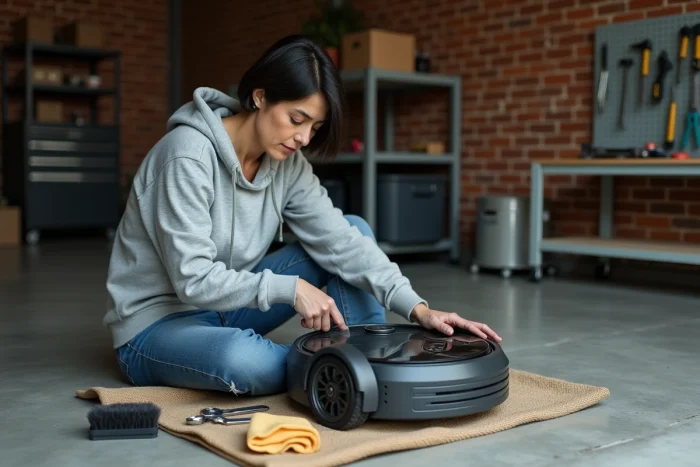
An oxidized contact at the time of storage will be a dead contact in the spring. A simple cleaning with isopropyl alcohol and an anti-static brush is enough to prevent this problem.
Cleaning the chassis and blades before winter storage
The underside of the robot accumulates a compact mixture of grass, dirt, and moisture that, if left in place for months, forms a corrosive crust. This mass retains water against mechanical components: wheel axles, cutting deck, motor housing.
Blades: removal or systematic inspection
We recommend removing the blades before wintering, not just inspecting them. Dirty or slightly stuck blades will continue to corrode during the winter. Upon restarting, the imbalance created by a partially blocked blade puts abnormal stress on the cutting motor.
Take this opportunity to replace worn blades. Storing them separately in a dry bag also avoids any risk of cuts during handling.
Cleaning the housing and sensors
Remove the upper shell and clear any plant residues inside the chassis. Never use a high-pressure water jet: pressurized water seeps into the seals of motors and electronic boards.
- Use a soft dry brush to remove residues from the cutting deck and around the wheels
- Clean the sensors (rain, shock, tilt) with a slightly damp cloth without aggressive solvent
- Check the condition of the housing seals: a cracked seal will allow moisture to enter throughout the winter
Optimal storage conditions and temperature errors
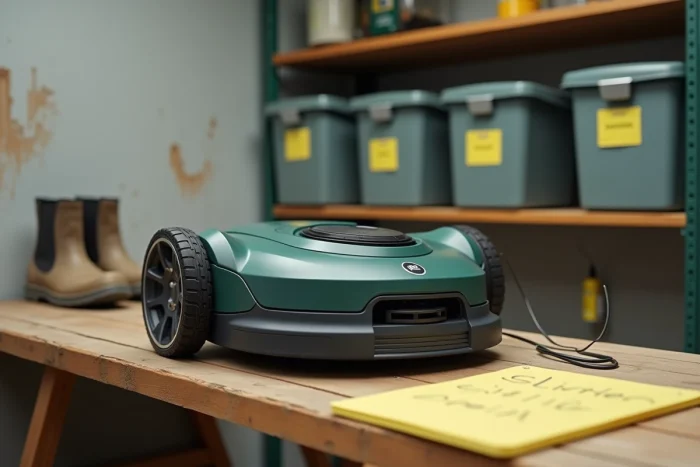
Storing a robotic mower in an uninsulated garden shed is one of the most common mistakes. Below 0 °C, the lithium-ion battery suffers internal damage that only manifests in the spring as loss of autonomy or refusal to charge.
The ideal is a frost-free, dry location with a stable temperature between 5 and 15 °C. An attached garage to the house is suitable in most cases. A basement can also work as long as the ambient humidity remains reasonable.
Intermediate recharge during winter
During a wintering period of four to five months, an intermediate recharge around the middle of the period helps keep the battery within its comfort range. Bring it back to half charge, no more. This precaution mainly concerns standard Li-ion packs. LFP batteries, due to their lower self-discharge, tolerate better storage without intermediate recharging.
Never recharge a battery whose temperature is below 5 °C. Allow it to return to room temperature in the storage area before plugging in the charger.
Spring restart: checks not to skip
The restart is not just about placing the robot on its base and starting a cycle. Before the first mowing, check the condition of the charging contacts, reinstall new or inspected blades, and perform a full charge followed by a short test cycle.
Also, remember to update the firmware if the manufacturer has released a new version during the winter. Some updates fix bugs in charge management or navigation that can affect the robot’s behavior during the first mowings.
A well-conducted wintering is measured in the spring: a robot that starts without loss of autonomy and without going to customer service is a sign that the chemistry, mechanics, and electronics were respected during the pause.