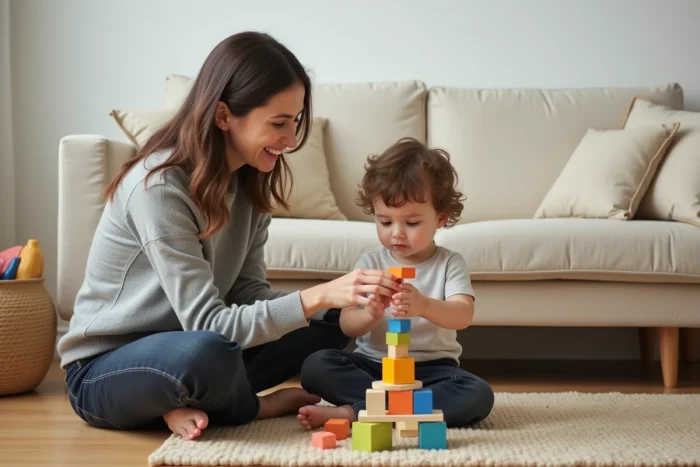
The first months with an infant involve a multitude of decisions that most parents discover along the way: choosing a childcare method, recognizing signs of fatigue, introducing solid foods. The French institutional framework has evolved in recent years to better structure this support, particularly through the deployment of postpartum follow-up systems and the creation of welcome spaces dedicated to young families.
Access to these resources varies greatly depending on the regions, and the daily lives of young parents often revolve around very concrete trade-offs, far from grand educational theories.
4-Month Postpartum Consultation: An Unevenly Accessible System
Among the recent developments in perinatal follow-up in France, the so-called “4-month postpartum” pathway deserves particular attention. Recommended by the Commission for the First 1000 Days, this systematic appointment aims to early identify postpartum depression and parental burnout, two realities that are often underdiagnosed in the weeks following childbirth.
The Haute Autorité de Santé has integrated this consultation into regional maternity pathways since 2023. The principle: to offer each parent a dedicated interview, distinct from the classic medical follow-up of the infant, to assess the psychological state of the mother (and the co-parent) and refer them to a psychologist or a PMI service if necessary.
Field feedback varies on this point. In some regions, the consultation is effective and well recognized by healthcare professionals. In others, the lack of available practitioners or the absence of coordination between maternity wards, independent midwives, and PMIs renders the system theoretical. For the parents concerned, the most reliable approach remains to explicitly request this appointment from their midwife or treating physician as early as the third month, without waiting for a summons that may never arrive.
Additional online resources exist for parents seeking concrete guidance on their child’s development and daily management, such as those available on petitsbambins.fr, which gather practical guides and advice tailored to different stages of early childhood.

Houses of the First 1000 Days: Local Support for Young Parents
Since 2023-2024, a new type of structure is being deployed across the territory: the “Houses of the First 1000 Days.” These free spaces offer thematic workshops (infant sleep, babywearing, nutrition, returning to work) and psychological support without an appointment for expectant and young parents.
The concept is based on a non-medicalized welcome, complementary to PMI and classic consultations. The idea is to create a place where parents can ask questions without a formal framework, meet other families, and benefit from the expertise of early childhood professionals.
What These Houses Offer in Practice
- Group workshops on specific topics: food diversification, managing crying, sensory awakening of the infant, with trained facilitators (nurses, psychomotor therapists, dietitians)
- A listening space for parents in emotional difficulty, without the need for prior diagnosis or medical prescription
- Information sessions on social rights (parental leave, CAF assistance, childcare methods) provided by social workers
The available data do not yet allow for measuring the impact of these structures on the health of the families who attend them. Their territorial coverage remains uneven: rural areas and priority neighborhoods, where needs are most pronounced, are not always the first to be served.
Sensory Awakening and Child Development Before Age 3
Supporting a child’s development on a daily basis does not solely rely on institutional systems. A significant part occurs in ordinary interactions: bath time, meals, moments of free play.
The sensory stimulation of infants, often presented as a domain reserved for specialists, actually relies on simple gestures. Varying textures, sounds, and body positions throughout the day is enough to nourish the neural connections of the young child. Early childhood professionals emphasize one specific point: excessive stimulation is as counterproductive as its absence.
Concrete Guidelines for Daily Awakening
Before multiplying sensory toys or directed activities, it is useful to focus on a few principles that consistently appear in the recommendations of parenting professionals:
- Allowing the infant to freely explore a safe space on the floor, without intervening systematically, promotes gross motor skills and bodily confidence
- Calm times without stimulation (no screens, no music, no toys) allow the child’s brain to process the accumulated information, a point that developmental neuroscience research regularly highlights
- Food diversification, beyond its nutritional role, constitutes a major sensory experience: new textures, temperatures, and flavors contribute to overall awakening

Parental Emotions and Mental Load: What Guides Don’t Always Mention
The majority of resources aimed at young parents focus on the child’s needs. The parental aspect often boils down to injunctions (“take care of yourself,” “sleep when the baby sleeps”) whose concrete application is rarely detailed.
The parental mental load is not limited to the logistical organization of the household. It includes the constant management of uncertainty: is my child eating enough, sleeping properly, developing at the right pace? This constant vigilance, documented by studies on parental burnout, affects both parents but weighs disproportionately on the one who spends the majority of time with the child.
Birth preparation sessions, recently expanded in France to include the co-parent, are beginning to address these issues. Some programs now include specific modules on task sharing and communication in the couple after the arrival of a child, an angle that has long been absent from traditional perinatal pathways.
French post-natal follow-up is progressing, but the gap between announced systems and their actual accessibility remains an open issue. For parents who feel isolated, the first useful step often remains the simplest: contacting the PMI in their area, which can direct them to available local resources, whether it be a 1000 Days space, a support group, or appropriate psychological follow-up.